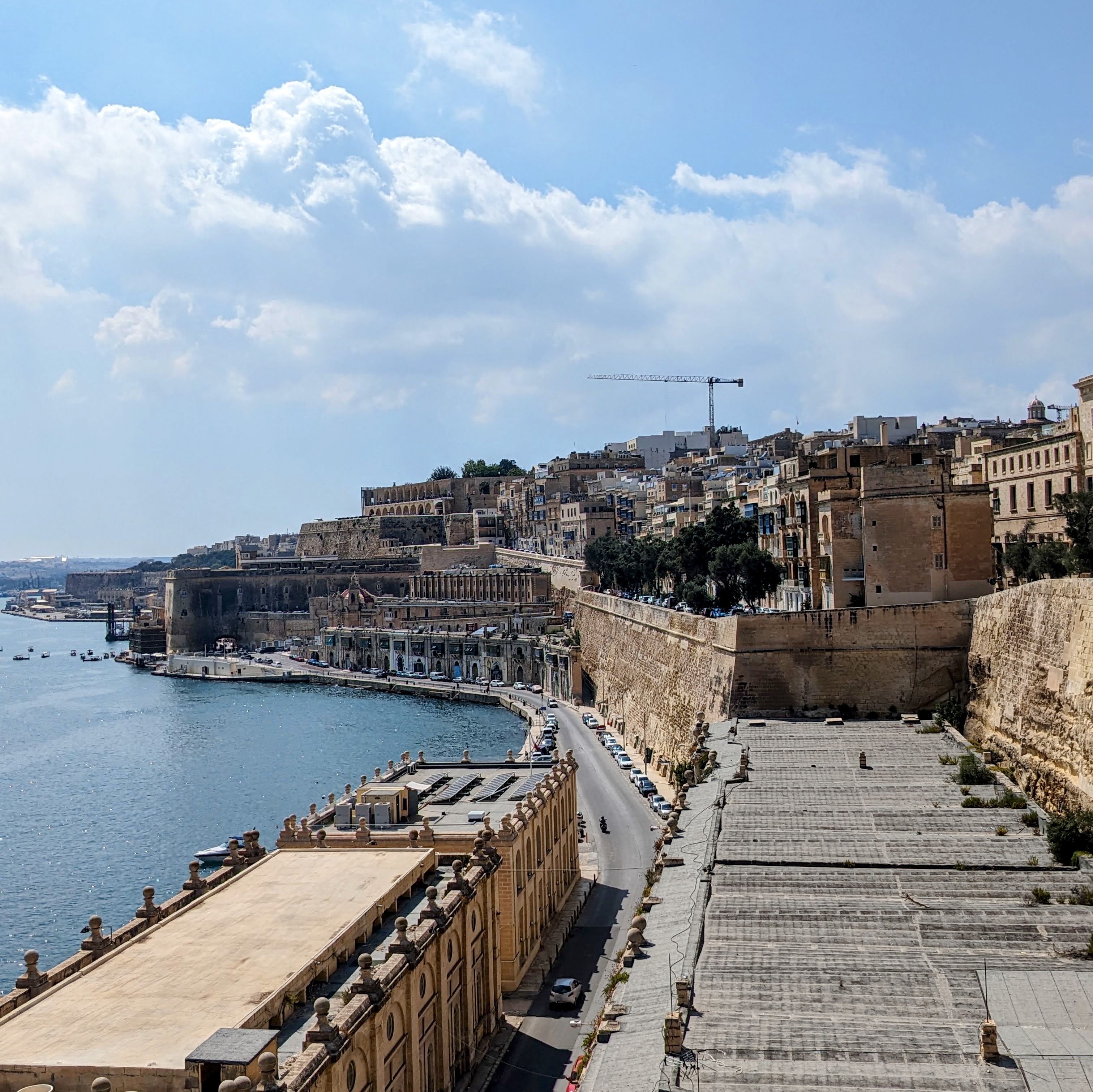
This is not a traditional travel guide. It pairs personal observations with practical advice for travelers who would rather see Malta as it is, with rough edges, loose ends, and all. Despite the tone, this guide contains practical planning advice, safety context, and logistical realities intended to help travelers decide whether Malta is right for them.
If you are a person who prefers to stay at home, perhaps with a good book and a cup of something hot, you have my sincere and unqualified admiration. Travel, you see, is a peculiar and often distressing activity, requiring one to leave the familiar miseries of one’s own dwelling in favor of the unfamiliar miseries of another. But if you are a person who, for some inexplicable reason, feels a compulsion to see the world, you may at some point consider a journey to the archipelago of Malta.
Malta, which is comprised of several islands – though you will likely only visit the two or three largest, as the others are either too small or too inaccessible to be of much use to anyone but a very small and very determined bird – is a place of a great many contradictions. You might imagine that you are traveling to a land of serene, sun-drenched beauty, a sort of seaside paradise. And while it is true that the sun is frequently in attendance, its heat can be a sort of particular and relentless torment, a perpetual reminder that you are not, in fact, relaxing, but rather slowly being roasted. The sea, too, is a point of confusion. It is an extraordinary shade of blue, a color so vivid and unnatural it seems to have been invented by a particularly ambitious painter. But the beaches are often not what you’d expect, being comprised not of the soft, accommodating sand one might desire, but rather a collection of rather unforgiving rocks, a fact that will be made abundantly clear to your feet.
But it was the topography of limestone and vertical ambition that led to my own profound humiliation in the capital city of Valletta. The city is laid out in a gridiron pattern, a fact that looks reassuringly orderly on a map but fails to account for the reality that these streets do not flatly intersect; rather, they plunge violently toward the sea or ascend into the sky via endless flights of shallow, punishing steps.
I had been told that these steps were originally constructed with a low, wide rise specifically to allow the armored Knights of St. John to ascend them comfortably on horseback, although I suspect this is a myth. But having neglected to bring a horse, and possessing legs of standard, un-armored human proportions, I found that walking up them requires a deeply unnatural, limping gait – taking two steps per tier or one massive, lunging stride. It was during an ill-advised mid-afternoon ascent of one such street, carrying an overly heavy tote bag, that my left knee gave a loud, acoustic pop. I spent the subsequent twenty minutes resting on a hot stone step, pretending to admire a nearby Baroque doorway while a procession of nimble French tourists and a local feral cat looked upon my perspiration-soaked distress with matching expressions of cold indifference.
The history of Malta is a matter of considerable distress. It is a story of one invading army after another, each leaving behind a peculiar architectural fingerprint. You will find yourself surrounded by stone fortifications of such grand and unyielding a nature that they seem to be preparing for a war that has not yet begun, a feeling that is, for a person of a nervous disposition, quite unsettling. The churches, in particular, are so ornate and gilded that they feel less like places of worship and more like elaborate and slightly overwhelming treasure chests. And in every corner of the island, you will find the eight-pointed cross of the Knights of St. John, a symbol that, like a persistent and rather dour acquaintance, is never far from your sight.
The language, which sounds like a unique and perplexing blend of Arabic and Italian with a dash of other influences, is a matter best left to the locals, as any attempt to master it will likely result in a great deal of misunderstanding. A simple question about the location of a public lavatory could, for all you know, be interpreted as a request for directions to a secret society of ranchers, a group you would likely prefer not to encounter.
Malta at a Glance
Best Time to Visit
April to June and September to October are the “Goldilocks” months. The Mediterranean sun is warm enough for swimming, but you won’t feel like you’re being slow-roasted. In the spring, the island is surprisingly green and covered in wildflowers before the summer sun bakes it into a dusty gold.
If you visit in July and August, prepare for the Sirocco winds – hot, humid air from the Sahara that makes sightseeing feel like an endurance sport. This is also when the island reaches peak capacity, and the narrow streets of Valletta become a sea of tourists. Winter (December to February) is mild and quiet; it’s too cold for the beach, but perfect for exploring 5,000-year-old temples without another soul in sight.
Currency
The Euro (€). Malta is generally card-friendly, especially in the mainstream hubs like Valletta. Most restaurants and boutiques will take your plastic without a second thought.
However, you’ll still want a pocketful of small euros for small village pastizzerias, and the traditional dgħajsa (water taxis) that ferry people across the Grand Harbour. Tipping follows the general European rule: 5 – 10% is customary in restaurants if service isn’t included. If you’re just grabbing a drink or a snack, rounding up to the nearest euro is perfectly fine.
Language
Malta is officially bilingual: Maltese and English. Maltese is a fascinating linguistic cocktail – it’s a Semitic language (related to Arabic) written in Latin script, heavily peppered with Italian and English loanwords.
Because of the British colonial history, English proficiency is near-universal. You will have absolutely no trouble communicating. You’ll hear locals switching between the two mid-sentence (Maltenglish). While you can get by entirely in English, a cheerful “Bonġu“ (Good morning) or “Grazzi“ (Thank you) will be met with a wide Maltese smile. Be warned: the local pronunciation of town names like Marsaxlokk (mar-sa-shlock) or Birżebbuġa (beer-ze-boo-ja) takes a bit of practice.
Cost Level
Moderate. Malta offers a high quality of life for a lower price tag than popular Italian cities or the South of France. You can live like a king on street food – the legendary pastizzi (flaky pastry filled with ricotta or peas) usually still costs less than a euro and is practically a national monument.
Accommodation in Valletta is pricey, but the surrounding towns are much more affordable. The public bus system is incredibly cheap and covers almost every inch of the island, though it operates on island time (the bus will arrive when it arrives). The most expensive part of your trip will likely be the boat charters to the Blue Lagoon or high-end dining in the capital’s historic palaces.
More Dire Travel Warnings About Malta
While a person of good sense understands that an island in the Mediterranean might seem like a grand and sun-drenched escape, the solemn warnings from the governments of the United States, the United Kingdom, and Canada suggest that even the most pleasant of voyages can contain its own dreadful situations. To venture to this particular locale is to risk a number of dreadful circumstances, each more vexing than the last.
- Health and Medical Preparedness: Even in a place that seems perfectly pleasant, one must still be prepared for the worst. The governments advise that you should have insurance, for although Malta has modern hospitals capable of handling most emergencies, a sudden and unpleasant illness could result in a most expensive and unwanted journey to a different country. And you must not overstay your welcome, as the number of days you are permitted to stay is a brief and unforgiving measure of time. A person of good sense understands that in this world, even in a place that looks like a paradise, a single foolish mistake can lead to a world of trouble.
- Petty Crime: With no surprise to anyone who has a proper understanding of the depravity of human nature, there is the matter of petty thievery. You see, some people have no shame, and they consider your pockets to be their business. In a place filled with bustling crowds and ancient streets, a hurried hand might find its way to your wallet, turning a simple stroll into a moment of pure dread. The governments’ advisories warn of these small, scurrilous acts, urging you to cling to your possessions as if they were a life raft in a very deep and very dark sea.
- Nightlife and Safety: While the evenings in some places are filled with harmless music and gentle company, the governments warn that the late hours in certain Maltese districts, such as Paceville, are a more perilous affair. It is in these places, full of loud noises and careless revelers, that one must be vigilant against reports of a particularly vile form of trickery: the spiked drink. As you know, a spiked drink is a beverage to which a terrible substance has been added, and it can turn a moment of cheer into a dreadful, foggy mess, often followed by an unfortunate visit to a hospital or, worse, an empty wallet.
- Traffic and Road Safety: For those accustomed to driving on one side of the road, Malta’s custom of driving on the other can be as baffling as a riddle without an answer. The roads themselves, being narrow and often tangled, are a perfect recipe for a collision, a fender bender, or a great deal of frustration.
These are just some of the misfortunes that await you in Malta. And although current as I write this, these travel advisories are ever-shifting documents, meaning that you, as a traveler, are in a constant state of uncertainty. You must check these advisories again and again, like a spy checking for a tail in every reflection. But even then, you will not have peace of mind, for a disaster can strike at any time, in any place, and in any form. To travel is to accept that you are living in a state of suspended dread.
Here are links to the most current travel advisories from these governments.
- Government of Canada Travel Advice and Advisories for Malta
- U.S. Department of State Travel Advisory for Malta
- United Kingdom Foreign Travel Advice about Malta
So, as you can see, even the most sober and formal of sources agree that Malta is not a place for the faint of heart. It is a country of layered sorrows, each one more complex and bewildering than the last. Do not say you were not warned, for the warnings are, I am afraid, everywhere.
Practical Realities
Public Transport
In Malta, the bus system is the only public transit game in town, and it is a test of both your patience and your grip strength. The fleet is modern and air-conditioned, but the roads were designed for donkey carts and Knights of St. John. A journey that looks like a ten-minute hop on a map can easily become a forty-minute odyssey through a labyrinth of limestone alleys.
And if a bus is at capacity, the driver will sail past your stop with a stone-faced indifference that borders on the majestic. You aren’t just waiting for a bus; you are participating in a lottery where the prize is a seat on a vehicle that may or may not be able to navigate the next hairpin turn.
Bolt, Uber, or eCabs are highly recommended and suspiciously affordable alternatives.
Rental Car Reality
Renting a car is a brave choice that involves driving on the left – a legacy of British rule – while adopting a Mediterranean creative approach to lane discipline.
Also, in Malta, a flashing amber light is rarely a signal of intent; it is more often a decorative feature or a sign that the driver accidentally bumped the lever while gesturing.
Parking in Valletta is not a matter of finding a spot, but of witnessing a miracle. If you find a space that doesn’t involve blocking a garage or a sacred religious shrine, take it and never move your car again.
Restaurant Timing
The service is laissez-faire, which means the staff will treat you with a warmth that suggests you’ve been friends for years, while simultaneously forgetting that you ordered a drink twenty minutes ago.
Dining is a slow, sun-drenched ritual. If you go for a Sunday lunch in Marsaxlokk, expect to be there until the sun starts to set.
When you want the bill, you must be proactive; in Malta, the hurried check is seen as a sign that the restaurant is failing in its duty to let you relax.
Bureaucracy
Digital life is a curious mix of high-tech iGaming infrastructure and the “I know a guy” system. You can pay for a pastizz with a tap of your watch, but if you need to resolve a real-world issue – like a lost ID or a parking permit – you will enter the realm of the “Mela”. This multi-purpose word is the lubricant of Maltese bureaucracy; it means “okay,” “well,” “obviously,” or “let’s see.” Most problems are solved not through a portal, but through a series of phone calls to cousins and acquaintances who know how the system works.
Pace of Life
The local guiding principle is “Mela,” which also doubles as the national philosophy of “it is what it is.” There is a deep, rhythmic calm to the islands, punctuated by the explosive noise of Festa season. Between May and September, life is measured in firework displays and brass bands. Do not mistake the shouting in the streets for an argument; it is simply the standard volume for discussing the price of tomatoes. Life here isn’t slow – it’s just heavily influenced by the heat and the realization that the sea isn’t going anywhere, so why should you?
Popular Destinations in Malta (and Why They May Disappoint)
A visit to Malta might seem like a joyful adventure into a land of ancient history, sun-drenched coasts, and clear, blue water. But to an individual with a more sensible understanding of the world’s cruel and unrelenting nature, it is nothing more than a sprawling and baffling collection of peculiar misfortunes, each location offering its own distinct and equally unsettling brand of misery.
Central & Harbour Region / Valletta (History, Baroque Architecture, Nightlife, Gastronomy, Cosmopolitan Cities)
- Valletta, the capital of this small archipelago, is a city so riddled with a sense of its own self-importance that one is immediately put on edge. Its narrow, winding streets, which may at first seem charming, are in fact a series of steep, punishing ascents and descents that serve as a constant and nagging reminder that a person is simply one small part of a great, human current that is, in all likelihood, headed toward a destination it does not wish to go. The Grand Harbour, while undeniably grand, is merely a great watery ditch upon which a person can pay a small fortune to be jostled about in a boat, staring at the reflections of impossibly old fortifications that seem to be on the verge of crumbling into the sea.

Northern & Coastal Region (Sandy Beaches, Coastal Resorts, Water Sports, Family Attractions)
- Popeye Village is a garish, ramshackle cluster of wooden hovels nestled in Anchor Bay, constructed for a 1980 musical film that most civilized people have spent decades trying to forget. It is a monument to eccentricity and primary colors, where the ghost of a squinting sailor and his olive-shaped paramour linger in the form of underpaid actors. It is a deeply unsettling place where the architecture appears to be melting, the sea is deceptively beautiful, and the air smells faintly of fried food and faded Hollywood ambitions.
Southern & Rural Region (Prehistoric Temples, Fishing Villages, Seafood, Countryside Trails, Coastal Cliffs)
- Mdina, a place of such bewildering and unsettling stillness, is known as The Silent City, a name that a person of discernment will recognize as a cruel and ironic joke. Here, ancient, sun-baked stone walls enclose a labyrinth of confusing alleyways that are so unnervingly quiet that you can hear the faint, echoing sound of your own footsteps, a sound that serves as a powerful and immediate reminder that you are, in all likelihood, alone in a place that has been a silent witness to a long and tragic history. To visit is to be a part of a slow-moving procession, shuffling dutifully past the grand, imposing homes of old noble families who are, in all likelihood, silently judging you from behind their closed doors.

- Marsaxlokk, a fishing village so saturated with the greasy smell of cooking fish and the relentless, deafening chatter of tourists, feels less like a local cultural event and more like a public and unavoidable dinner party. Its famous harbor, filled with a great number of peculiar and brightly painted boats, is a colourful but ultimately confusing sight, a visual cacophony that serves to distract one from the very serious and very unsettling business of life. The daily market, a sprawling and chaotic collection of stalls, is a place where you will find yourself jostled by crowds, tempted by things you do not need, and reminded of the fact that happiness, like a fresh fish, is often best experienced in small, solitary doses.
- Mosta is a Maltese town dominated by a dome so shockingly massive it defies both architectural modesty and common sense. The Rotunda of Mosta is famous for a historical incident involving a Luftwaffe bomb that crashed through the ceiling during World War II and, in a rare moment of divine politeness, failed to explode. Visitors stand beneath this echoing cavern of stone, looking upward with a mixture of awe and the lingering anxiety that at any moment, history might decide to drop something else on their heads.

- Ħaġar Qim and Mnajdra Temples are prehistoric ruins of an antiquity so profound it makes your great-grandmother look like a newborn infant. Older than the Pyramids and significantly more mysterious, these megalithic structures were dragged into place by people who left no written records, no explanations, and an unsettling number of plump limestone statues. To wander through these sunburned, wind-scraped temples is to feel the crushing weight of millennia, and to wonder if the ancients built them as places of worship, or merely as a very elaborate way to confuse future generations.

- Dingli Cliffs consist of a dizzying precipice where the island of Malta abruptly decides it has had quite enough of the land and plunges violently into the wine-dark Mediterranean Sea. It is a bleakly beautiful expanse, perfect for a somber walk, a deep, philosophical sigh, or the realization that you are standing on the absolute edge of a shelf of rock with nothing but gravity and hungry waves beneath you. The wind here howls with the voices of a thousand forgotten sailors, or perhaps it is just the sound of tourists realizing they have forgotten their jackets.

Gozo & Comino (Rural Serenity, Pristine Lagoons, Ancient Monolithic Sites, Diving, Agritourism)
- Gozo, the sister island, presents itself as a more serene and pastoral alternative, but this is merely a cruel and ironic joke. Here, the landscape, with its harsh, rocky terrain and its great, wind-battered cliffs, is a constant and nagging reminder that nature is not, in fact, your friend. The famous Ggantija Temples, a collection of immense and ancient stones, are a baffling and unsettling sight, a monument to a long and tedious history of human toil that serves no purpose other than to remind a person of the terrifying power of things they cannot possibly understand.
- And then there is the island of Comino and its famous Blue Lagoon. A place so saturated with the sun and the clatter of small boats that it feels less like an idyllic paradise and more like a public and unavoidable dinner party. The water, an improbable shade of clear turquoise, is so astonishingly beautiful that it serves as a powerful and immediate reminder that not all good ideas are, in fact, good, for it is often crowded with so many people that you can barely see the water at all. The very air is thick with a humidity that is as oppressive as a tyrannical government, and the music that blares from the loudspeakers is a cacophony of such bewildering noise that it can only be described as a public display of sound-related confusion.
Who Malta Is (and Isn’t) For
✔️ Good for:
- History and Culture Enthusiasts: Those interested in exploring 5,000-year-old temples, ancient fortifications, historic palaces, ornate churches, and towns steeped in a long history (like Valletta and Mdina).
- Budget-Conscious Foodies and Travelers: People looking for a high quality of life for a lower price tag than many popular Mediterranean destinations, who enjoy cheap street food (like pastizzi), and affordable public transit.
- English Speakers: Travelers who want near-universal English proficiency for effortless communication, thanks to Malta’s officially bilingual status.
- Off-Season Explorers: People who enjoy mild, quiet winters perfect for sightseeing without crowds, or those who prefer Goldilocks months (April – June and September – October) for warm swimming weather without extreme heat.
- Patient, Laid-Back Travelers: Those who can embrace a deep, rhythmic calm, island time bus schedules, laissez-faire restaurant service, and a slow, sun-drenched pace of life.
❌ Not ideal for:
- Soft Sand Beach Lovers: Travelers expecting pristine, accommodating sand beaches, as Malta’s coastlines are often comprised of unforgiving, rocky terrain.
- People with a Nervous Disposition or Lovers of Quiet: Those easily unsettled by grand, unyielding stone fortifications, explosive noise during the summer Festa season, loud shouting in the streets, and bustling crowds.
- Anxious Drivers: Anyone uncomfortable with driving on the left side of the road, aggressive Mediterranean creative lane discipline, narrow tangled roads, or the near-impossible task of finding a parking spot in hubs like Valletta.
- Those Seeking Solitude at Popular Sights: People who dislike highly crowded, tourist-heavy spaces, loud music, and a visual cacophony, which plague hot spots like the Blue Lagoon (Comino), Marsaxlokk’s markets, and Valletta in the peak summer months.
- Heat-Sensitive Travelers: Anyone who cannot tolerate intense, relentless summer heat or the hot, humid Sirocco winds from the Sahara during July and August.
- Impatient or Highly Structured People: Travelers who get easily frustrated by delayed public buses that sail past stops when full, slow restaurant service where you must aggressively ask for the bill, or a bureaucratic system relying on phone calls to cousins rather than digital portals.
So, as you can see, Malta offers a vast and varied landscape of despair. If you are a person who enjoys a journey filled with baffling architecture, an uncooperative climate, and the constant, unnerving presence of historical conflict, then Malta is the place for you. For the rest of us, a much more sensible course of action would be to take a nap and let other people chase the disappointment for once.
Here’s more dismal content you might enjoy:


Something went wrong. Please refresh the page and/or try again.