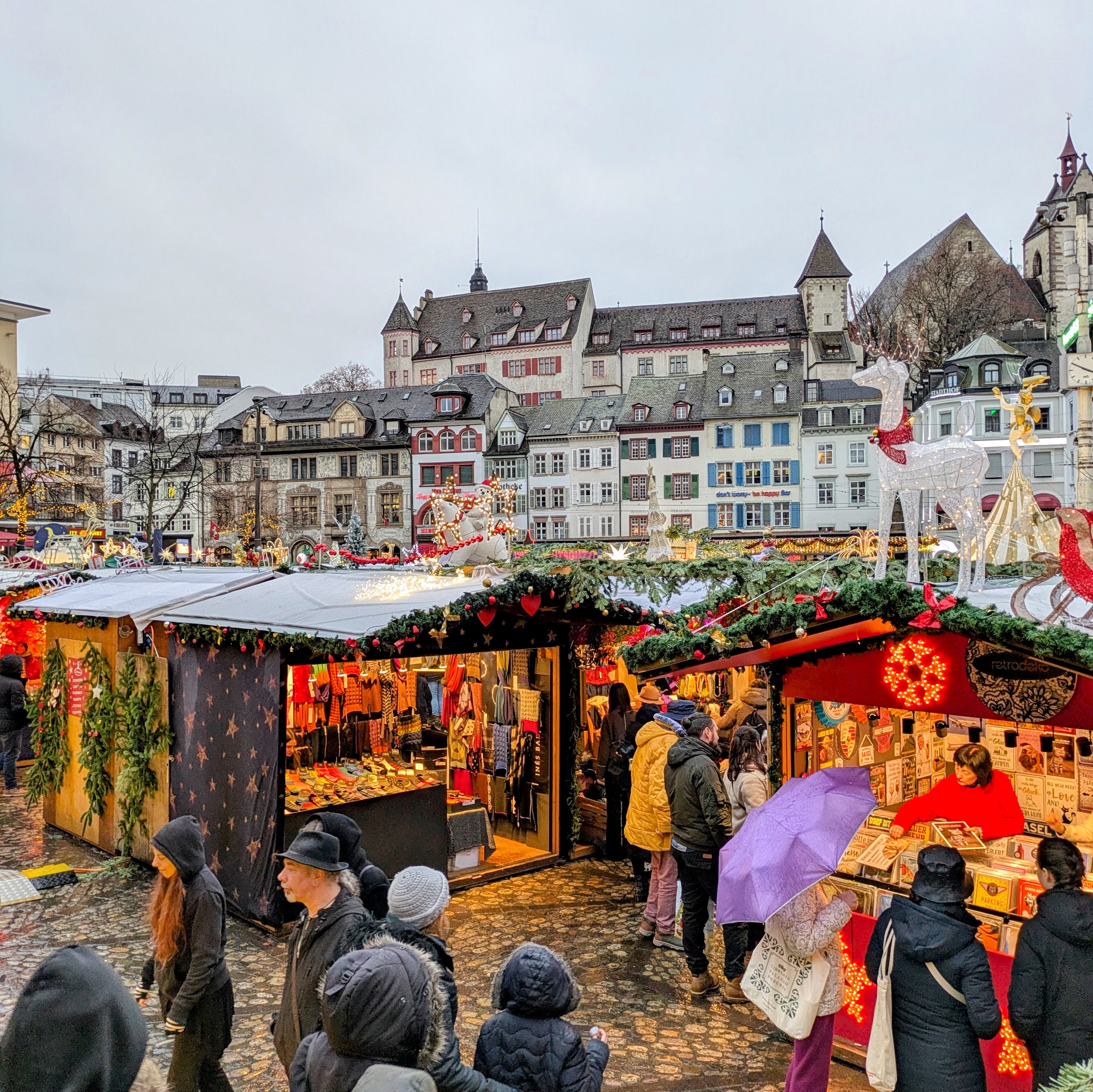
Dear fellow traveler, this is not your typical Basel restaurant guide. The recommendations contained herein are born of my own experiences, though on certain miserable occasions where I could not visit a restaurant myself, I have relied on the accounts of experts – people whose professional lives are spent in the pursuit of a decent crust of bread.
I must warn you: despite the sometimes gloomy tone of my writing, the dishes and establishments mentioned are, regrettably, quite real and currently serving the public.
So if you have acquired this volume under the misguided and utterly melancholic impression that it will lead you to a series of cheerful, uncomplicated meals, then you have made a grievous error. Basel, perched precariously on the Rhine River, is an intersection not only of three tiresome territories – Switzerland, France, and Germany – but also of innumerable ways to find yourself deeply, regrettably dissatisfied. Do you hunger for the local specialties? Prepare for Basler Läckerli, a biscuit so hard and hazardous it could be used as a blunt instrument, or perhaps Basler Mehlsuppe, a flour-based soup that sounds suspiciously like what one scrapes from the bottom of a pantry. Do not be fooled by the charming cobblestones and the promise of tasty treats; these are mere deceptive details masking the essential truth: dining out is often a deeply distressing and dangerous endeavor. Proceed with the grim knowledge that a satisfied stomach is a rare and fleeting form of fortune, and one that is unlikely to be found if you continue reading.
Here you have it: a list of Basel restaurant recommendations, gathered from a patchwork of sources – friends, travel guides, locals – each as trustworthy as a leaky umbrella in a downpour. The unfortunate truth is, I haven’t actually eaten at most of these places myself. Yes, it’s a grievous omission, but sometimes one must rely on others, even when those others could recommend a fine dining experience one day and a disaster the next. So, proceed with caution. You might discover a culinary delight – or you might find yourself facing a meal so disappointing, it could ruin your appetite for years.
- Best Restaurants in Basel
- Local Specialties
- Traditional Restaurants in Basel
- Markets and Foodie Neighborhoods
- Food Tours
Best Restaurants in Basel
To prevent my predictable calamity of leaving Basel without having tasted its most exquisite delicacies, I must reluctantly insist you dine at hotel brasserie au violon.
And if you’re looking for things to do in Basel other than eat, read The Truth About Basel’s Best Sights.
Local Specialties
These are the bewildering traditional and local dishes that you should look forward to eating – or at least seek out for the purposes of historical documentation – during your ill-advised visit to Basel.
- Basler Mehlsuppe: Do not expect a light, cheerful broth; this is a brown, unsettlingly opaque liquid made from flour that has been roasted in butter until it achieves a toasted, muddy hue. It is traditionally consumed at four o’clock in the morning at the start of the Fasnacht – the local carnival – a time when both the hour and the prospect of flour soup should be enough to send any sensible person running in the opposite direction. The dish is merely a starchy, temporary bulwark against the exhaustion of ceaseless merriment, proving that even joy is best accompanied by a slight feeling of heaviness.
- Käse- und Zwiebelwähe: The name means Cheese and Onion Tart, a phrase that carries all the excitement of an overdue flu vaccine. This is Basel’s version of a quiche or savory pie, typically a flat, tray-baked item where the meekness of the dough struggles to contain the cloying intensity of the cheese and onions. It is another Fasnacht staple, suggesting that when the town attempts to celebrate, the first thing it turns to is a simple, overwhelming wall of dairy and allium, a combination that promises long-lasting and socially regrettable consequences.

- Fastenwähe: This is a small, soft, ring-shaped, or sometimes cross-shaped bread roll, best described as a pretzel that has lost its nerve and its rigid exterior. Its most distinguishing – and most alarming – feature is its heavy sprinkling of caraway seeds, tiny, insistent dots of flavor that cling to the dough and follow you throughout the day. Its name means Fasting Pie, as it was historically baked during the period of Lent – a grim reminder that even when seeking spiritual contemplation, the locals still couldn’t resist a rich, yeasted carbohydrate, proving that human weakness is as inevitable as an unpaid bill. The Cervelat – a local sausage (known as Chlöpfer in Basel dialect), a smoky, emulsified tube of meat – is the customary accompaniment, often sliced cold into a salad, but when consumed on its own, it is merely a humble, unadventurous filler that offers little relief from the bread’s insistent caraway.

- Basler Läckerli: The name Läckerli literally means little delicious thing, which is, of course, a trap. These are hard, rectangular spice biscuits, like a stubborn, heavily-spiced brick. They are made from honey, almonds, candied peel, and a generous quantity of Kirsch (cherry brandy), all mixed, baked flat, and then, while still warm, brushed with a thin, brittle sugar glaze. The Läckerli is not a cookie to be delicately munched; it is a dental challenge, requiring a level of jaw strength that one should never have to employ while eating a confectionery item. Its history, dating back to the 17th century, is merely a testament to human resistance to easily digestible pleasures.

Traditional Restaurants in Basel
Volkshaus Basel
Website | Map | Reservations
This is a Brasserie, a French term for a large, noisy, and often brightly lit establishment that offers no true sanctuary. The sheer, unadorned glass and concrete of its architecture merely reflect the cold, sterile indifference of the universe to your personal dining pleasure. It is a communal space where one is forced to confront the shared, uninspired taste of the masses.
- Go anyway because: Designed by Herzog & de Meuron, the space is an architectural masterclass in minimalism that makes your personal dining pleasure feel significantly more sophisticated, even if the universe doesn’t care.
- Good for: A sleek, sterile evening where the aesthetic of the room is as crisp as the wine.
- Order: The Bouillabaisse or the Saltimbocca.
- Price: €€€ (Upper-Moderate). Approximately 35 – 60 CHF.
- Additional tips: The courtyard is an unadorned oasis in the summer; use the glass and concrete to shield yourself from the uninspired noise of the street.
- Also recommended by: Lonely Planet, Eater, Architectural Digest, and minimalist enthusiasts who find that less is more applies to both decor and emotional outbursts.
hotel brasserie au violon
Website | Map | Reservations
This Michelin-recognized brasserie is a place where high standards and high prices are enforced, guaranteeing an anxious, tense experience. The sophistication of the cuisine merely serves as a subtle, expensive reminder that even in Swiss serenity, true contentment remains perpetually out of tune.
- Go anyway because: It is located in a former prison, which is a delightfully honest setting for those who feel trapped by high-end dining. The French-inspired cooking is technically flawless.
- Good for: An anxious romantic dinner where the excellence of the food is the only thing keeping the conversation from falling out of tune.
- Order: The Duck Confit or the Tarte Tatin.
- Price: €€€ – €€€€ (Expensive). Approximately 40 – 75 CHF for a main course.
- Additional tips: Request a table in the cell wing if you want the architecture to match your internal sense of confinement.
- Also recommended by: The Michelin Guide (Bib Gourmand 2026) and former inmates who find the current sentence of three courses much more palatable than the original.
Gifthüttli
Website | Map | Reservations
The name, meaning Poison Hut, is the only honest thing about the place. It promises a dangerous excitement but delivers a mere collection of hearty, heavy local dishes. The atmosphere is falsely jovial and cramped, ensuring that every patron feels a claustrophobic proximity to their neighbor and, inevitably, to their own poor dietary choices.
- Go anyway because: It is the undisputed home of Cordon Bleu in Basel, offering dozens of variations of fried, cheese-stuffed meat that justify the dangerous excitement of the name.
- Good for: When you want to embrace claustrophobic tradition and drown your poor dietary choices in a sea of melted Gruyère.
- Order: Any of the Cordon Bleu variations (the classic is a safe harbor in a storm of cheese).
- Price: €€ (Moderate). Approximately 30 – 45 CHF.
- Additional tips: It is almost always packed; expect to become intimately acquainted with the neighbor whose elbow is currently in your salad.
- Also recommended by: Cheese-addicts who find that poison is a fair price to pay for a stuffed veal cutlet.
Restaurant Löwenzorn
Website | Map | Reservations
Löwenzorn hides behind an impressive, historic facade, lulling you into the false belief that tradition ensures quality. Instead, you are confronted with predictable, uninspired meals served in an environment that mistakes stiff formality for genuine sophistication. The only Zorn (wrath) you will feel is at the bill.
- Go anyway because: The building is a 16th-century masterpiece with a stunning courtyard that makes the stiff formality of the service feel like a necessary historical reenactment.
- Good for: A predictable business lunch where the gravity of the room helps mask the uninspired nature of the conversation.
- Order: The Zürcher Geschnetzeltes (sliced veal in cream sauce) with Rösti.
- Price: €€€ (Upper-Moderate). Approximately 35 – 55 CHF.
- Additional tips: Don’t let the wrath of the bill ruin the view of the historic wood carvings; you are paying for the 500-year-old atmosphere, not just the veal.
- Also recommended by: Local historians who prefer their uninspired meals to be served in rooms with significant heritage.
Schlüsselzunft
Website | Map | Reservations
This establishment is housed in a guild hall, a miserable reminder of a structured, organized past that has no bearing on the chaotic misery of modern dining. The menu is a predictable litany of Swiss classics – all perfectly adequate, perfectly joyless, and served with a solemnity that suggests eating is a grim civic duty.
- Go anyway because: It features a magnificent, floor-to-ceiling ceramic tile stove from 1773; the grim civic duty of eating is much easier to perform when warmed by eighteenth-century engineering.
- Good for: When you want your chaotic misery to be temporarily calmed by the heavy, structured silence of a medieval guild.
- Order: The Chateaubriand or the Sole Meunière.
- Price: €€€ – €€€€ (Expensive). Approximately 45 – 90 CHF.
- Additional tips: It is located in the heart of the shopping district; use the solemnity of your meal to recover from the chaotic misery of the nearby stores.
- Also recommended by: Corporate boards who find that perfectly adequate is the ideal setting for a three-hour merger discussion.
Markets and Foodie Neighborhoods
Markthalle Basel
This vast, domed structure is less a market and more a cacophony of competing food stalls, a testament to indecision and culinary sprawl. One must wander aimlessly, overwhelmed by choice and the smells of a hundred different, mediocre cuisines, only to settle on something slightly cold and consumed while standing uncomfortably.
- Go anyway because: The concrete dome, built in 1929, was once the third-largest in the world; it provides a magnificent, cavernous space where the echoes of your indecision can reach their full, resonant potential.
- Good for: Large groups of indecisive people who cannot agree on a single tragedy and prefer to suffer through a dozen different small ones simultaneously.
- Order: A craft beer from the central bar and whatever international stall has the shortest line – the mediocrity is more palatable when it doesn’t involve a long wait.
- Price: € – €€ (Economical to Moderate). Approximately 15 – 30 CHF.
- Additional tips: There is a large slide inside for children; it is a perfect metaphor for the rapid, frictionless descent into the urban sprawl below.
- Also recommended by: Office workers who find that wandering aimlessly is a valid alternative to returning to their desks.
Food Tours
If you haven’t the faintest wretched idea where to begin, a food tour is a particularly efficient reprieve from the agony of choice, allowing you to sample a disheartening variety of morsels over the course of a few fleeting hours. Here are a handful of options that are, by general consensus, well-regarded.
En Guete!
And now, having painstakingly traversed the tempting yet tormenting terrain of Basel’s eateries, we must draw this unhappy narrative to its inevitable close.
You have been shown the addresses, the absurd prices, and the unfortunate dishes. Whether you chose a simple, regrettable Cervelat sausage from a street vendor or suffered through the stuffy, sorrowful silence of a high-end French-influenced establishment, the outcome is invariably the same: a moment of consumption followed by a lingering lament.
Put this guide down, fellow traveler, and understand that in a world so thoroughly saturated with woe, even the act of seeking nourishment becomes a calculated risk. May your journey away from this culinary crossroads be swift, and may your next meal involve ingredients less likely to result in an unexpectedly acrimonious experience. I, however, am already anticipating the next, equally unsettling city.
Here’s more dismal content you might enjoy:


Something went wrong. Please refresh the page and/or try again.