This is not a traditional travel guide. It pairs personal observations with practical advice for travelers who would rather see Lithuania as it is, with rough edges, loose ends, and all. Despite the tone, this guide contains practical planning advice, safety context, and logistical realities intended to help travelers decide whether Lithuania is right for them.
My most sincere condolences. It seems that you are contemplating a trip to the nation of Lithuania. You have, I suspect, been misled by those with a vested interest in your misery – travel agents, perhaps, or a well-meaning but ill-informed friend. Any Lithuania travel guide will speak of ancient history, of charming old towns, and of a landscape dotted with castles. What they fail to mention is that these so-called attractions are merely a thinly veiled collection of disappointments.
You see, when one is traveling, one is often subjected to a series of firsts, which are sometimes fascinating and sometimes merely bewildering. Many years ago, during a solo backpacking journey, I spent a few days in Lithuania. And it was there, you see, that I first found myself relying on the kindness (or perhaps recklessness) of strangers for transportation. Specifically, I found myself hitchhiking, which involves standing by the roadside and hoping that the next vehicle is not carrying anyone who means you ill will.
More curious still was the experience with a certain official on a train, for it was then that I tried, for the first and last time, to convince a passport control official with a small offering of currency to overlook some administrative unpleasantness. This attempt, I assure you, was as unsuccessful as an umbrella in a hurricane. I was promptly, and with an air of profound disapproval, instructed to get off at the next stop, where I was then obliged to wait for a train that would take me precisely back to my starting point of Vilnius. After this minor setback, I spent an extra night in Vilnius before departing. The next day, I left not by rail or by thumb, but in a decidedly less dramatic fashion: upon a bus, heading in an entirely different and considerably safer direction.
You must understand that Lithuania is a place where history is not something to be celebrated, but a cold and heavy burden, much like a suitcase filled with bricks instead of clothes. You will be told to visit Vilnius Old Town, which is a labyrinth of dark, twisting alleyways and somber, peeling plaster, a place where one could easily become lost and forgotten, much like a footnote in a long and tedious biography. The spires of the churches, while seemingly reaching for the sky, are in truth just trying to escape the oppressive grayness of the climate, a grayness that will follow you everywhere you go, like a particularly morose shadow.
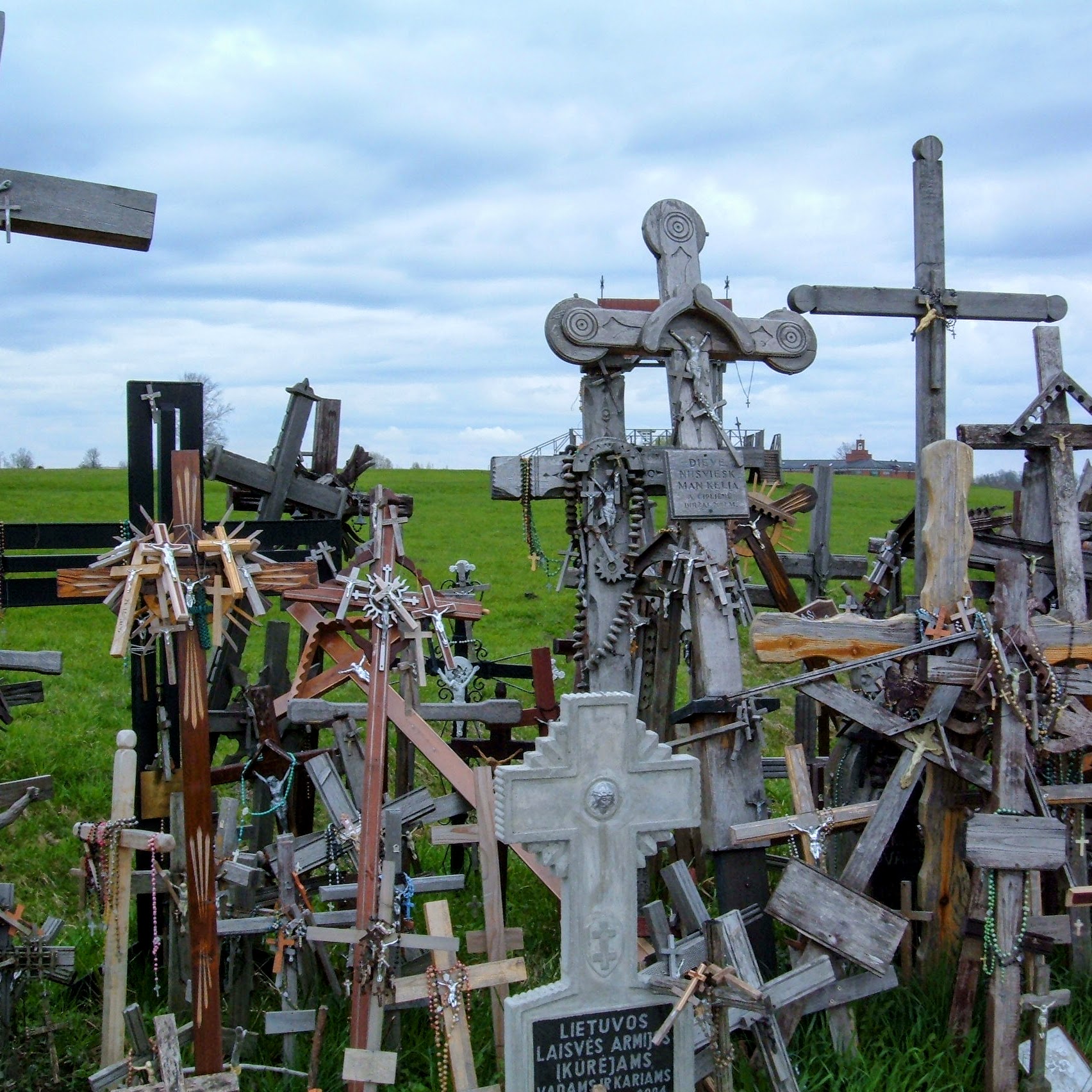
You may hear of a place called the Hill of Crosses, a grim and unsettling landmark where people have, for reasons I can scarcely fathom, placed thousands upon thousands of crucifixes. This is not a place of cheerful pilgrimage, but a desolate and windswept hill that serves as a monument to sadness, a stark reminder that even in a world filled with misery, there is always room for a great deal more. It is the sort of place that would make even a determinedly cheerful person feel a profound sense of woe.
And then there is the countryside. You will be told of lakes and forests, and you may imagine a peaceful, verdant landscape. You would be wrong. These forests are dense and foreboding, filled with ancient trees that stand in silent judgment, and the lakes are as still and uninviting as a pond in a graveyard. The infamous Curonian Spit, a long stretch of sand and sea, is not a place of beachy fun, but a windswept peninsula where the dunes are constantly shifting, as if the land itself is trying to escape its own dreadful fate.
The food, I will admit, is hearty, but this is merely a deceptive comfort. A potato dumpling, known as a cepelinai, is a very heavy meal, and the feeling of a leaden stomach is a fitting accompaniment to the leaden skies and leaden mood of the country itself.
Lithuania at a Glance
Best Time to Visit
May to September is when Lithuania truly emerges from its slumber. During this window, the country is a lush, vibrant green, and the sun stays up late enough to make you forget that winter ever existed.
If you enjoy the aesthetic of a medieval fairy tale, December is magical, provided you don’t mind the sun giving up and going home by 4:00 PM.
January and February are for those who want to experience the Great Baltic Freeze, where the landscape turns into a stark, snowy-slushy tundra and the wind feels like it’s personally offended by your presence.
Currency
The Euro (€). Lithuania ditched the Litas in 2015 and hasn’t looked back. Card payments (Visa/Mastercard) are the norm in cities like Vilnius and Kaunas – you can tap for a single coffee or a bus ticket without a second thought.
However, if you venture into the deep woods or a local Kaziukas street fair, you’ll want some coins. Those beautiful hand-carved wooden spoons and smoked eels rarely come with a card reader. Also, keep a few cents handy for public restrooms; in Lithuania, nature may be free, but the infrastructure to answer its call is usually 50 cents.
Language
The official language is Lithuanian, a tongue so linguistically ancient it makes Latin look like a modern invention. It is one of the oldest living Indo-European languages, sharing surprising structural DNA with Sanskrit – meaning it sounds like a melodic, mysterious chant from a forgotten era.
Younger Lithuanians speak English with effortless fluency, often better than those who grew up in London. However, be aware that for the older generation, Russian was the mandatory second language. Given the region’s history, a “Ačiū” (pronounced ah-choo, like a sneeze) goes much further than a Russian “Spasibo” in winning local hearts.
Cost Level
Refreshing. Lithuania remains one of the most budget-friendly corners of the European Union. While prices in the capital have crept up, you can still find a pint of local beer for the price of a bottled water in Paris, and a hearty meal of cepelinai (potato dumplings the size of a small aircraft) won’t require a loan.
It’s the kind of place where you can feel like a high roller on a mid-range budget, though the Curonian Spit in high summer will do its best to convince you otherwise.
More Dire Travel Warnings About Lithuania
If you’ve read this far and are still contemplating a journey to Lithuania, you must be prepared for a parade of predicaments, as a variety of government warnings have made perfectly clear. Travel advisories, for those unfamiliar, are documents filled with grim prophecies and cautionary tales, serving as a reminder that even in the most picturesque of places, misery is lurking just around the corner.
- Petty Crime: You must understand that this country, while it may appear serene, is not without its share of bad guys. These people, with their dreadful habits, are fond of a practice known as petty crime. They are particularly skilled at separating you from your wallet in crowded places, and they have a distinct fondness for the contents of unattended bags. If you are foolish enough to be traveling by automobile, you must know that there are bad guys who will either make off with your vehicle entirely or, at the very least, take whatever you have foolishly left inside.
- Overcharging Scams and Drink Spiking: For those who enjoy an evening out, a great deal of sorrow awaits. There are certain establishments where the bartenders have a cruel sense of arithmetic, and the final bill will be, in a most distressing fashion, several times what you had anticipated. This deplorable practice of overcharging is often accompanied by an even more malevolent act: adding unpleasant substances to your beverages. This drink spiking, a truly evil pursuit, can render you utterly helpless and is to be avoided at all costs. You should never, under any circumstances, leave your drink unattended.
- Border with Belarus and Russia: One must not ignore the grim geographical reality of the situation. Lithuania is nestled next to two particularly dreadful neighbors: Belarus and the Russian exclave of Kaliningrad. The borders with these places are, to put it mildly, unstable. Much like a rickety staircase, they could close without a moment’s notice, trapping you in a most inconvenient situation.
- Laws and Regulations: The authorities demand that you carry identification at all times, so that they may know exactly who is in violation of the many rules. And should you, in a moment of utter folly, find yourself in the company of illicit substances, you will be met with a punishment so severe that it would make a sensible person weep.
These are just some of the misfortunes that await you in Lithuania. And although current as I write this, these travel advisories are ever-shifting documents, meaning that you, as a traveler, are in a constant state of uncertainty. You must check these advisories again and again, like a surgeon watching the monitor for a flatline. But even then, you will not have peace of mind, for a disaster can strike at any time, in any place, and in any form. To travel is to accept that you are living in a state of suspended dread.
Here are links to the most current travel advisories from these governments.
- Government of Canada Travel Advice and Advisories for Lithuania
- U.S. Department of State Travel Advisory for Lithuania
- United Kingdom Foreign Travel Advice about Lithuania
So, as you can see, even the most sober and formal of sources agree that Lithuania is not a place for the faint of heart. It is a country of layered sorrows, each one more complex and bewildering than the last. Do not say you were not warned, for the warnings are, I am afraid, everywhere.
Practical Realities
Public Transport
In Vilnius, the trolleybuses are a tangle of retro-futuristic wires and surprising punctuality. They navigate the cobblestones with a hum that suggests they’ve seen it all. Elsewhere, the train network connects the major hubs of Kaunas and Klaipėda with modern, double-decker carriages that feel like a secret European luxury.
However, if you are heading to the Hill of Crosses or a remote lake in Aukštaitija, you will be boarding a Mikriukas – a minibus that operates on a schedule known only to the driver and a few select locals, and those who know you can now track the buses with autobusubilietai.lt.
Rental Car Reality
Renting a car is a smooth process, but you must be prepared for the Via Baltica experience. This stretch of highway is a high-speed artery where trucks from across the continent jostle for space.
You must watch for the Green Wave. In many cities, traffic lights are synchronized to reward those driving exactly the speed limit with a string of green lights. Deviate by 5 km/h, and you will be punished with a red light at every single intersection.
Also, be wary of the country roads at dusk; the local elk and wild boar have a habit of claiming the asphalt as their own, and they do not yield to anything smaller than a tractor.
Restaurant Timing
The service is honest, which means the staff will not pretend to be your best friend. In a traditional Užeiga, the food – mostly variations on the glorious, heavy potato – arrives when it is ready, and not a moment sooner. The national dish, Cepelinai, takes time to perfect; do not rush the chef unless you want a cold, starchy heart.
If you want the bill, you must ask for “Sąskaita.” If you simply sit there, the server will respect your privacy so thoroughly that you may still be sitting there when the next basketball season begins.
Bureaucracy
Digital life in Lithuania is lightning-fast; this is a country that treats high-speed fiber-optic cable as a human right. You can tap your card for a Šaltibarščiai (pink soup) in almost any stall. However, the ghost of the Antspaudas (official stamp) still haunts the more formal institutions. While you can sign documents with a mobile ID, if you need to return a physical item to a store or deal with a government clerk, prepare for a level of precision that requires every “i” to be dotted and every form to be pristine.
Pace of Life
The local guiding principle is a stoic, hardworking calm, balanced by a sudden, fiery passion for basketball. During a major game, the streets empty and the national pulse stabilizes around the flight of a ball.
Do not mistake their reserved Baltic nature for coldness; Lithuanians are deeply hospitable once the ice is broken, usually with a glass of mead or a shared plate of fried bread with garlic. Life is measured in the ancient roots of their language and the amber found on the Baltic shores. They aren’t in a hurry to catch up to the West; they are quite content waiting for the West to catch up to them.
Popular Destinations (and Why They May Disappoint)
To visit the nation of Lithuania is to step into a land that, much like a book of sad poems, is both beautiful and filled with a profound sense of melancholy. It is a country of ancient forests and bewildering swamps, a place that has been occupied and reoccupied by a great many people with a great many unsettling plans. A person of a cheerful disposition would find their spirits dampened by the history, and a person who is fond of straightforward explanations would find themselves utterly bewildered by the many and peculiar contradictions.
For those who are, for reasons that can only be described as ill-advised, intent on traveling to Lithuania, I have compiled a list of particularly distressing destinations:
- Vilnius: The capital, a city whose medieval Old Town is so perfectly preserved that it is almost a cruel joke. One can wander its cobblestone streets and admire a collection of Baroque churches, all of which are, of course, a testament to a long and complicated history of religious fervor and political turmoil. One of its most peculiar features is the self-proclaimed Republic of Užupis, a small district of artists and miscreants with its own constitution, which includes such unsettling pronouncements as “A dog has the right to be a dog,” and “Everyone has the right to be unhappy.”

- Trakai Castle: A castle so perfectly situated on an island in a lake that it appears to have been placed there by a particularly romantic and equally devious stage manager. It is a red-brick fortress that, while beautiful to behold, has a long and rather grim history of being a defensive stronghold. A person in a rowboat might find themselves looking at this fortress and wondering about all the unfortunate people who were besieged within its walls.
- The Hill of Crosses: This is not a destination for the faint of heart or the easily unnerved. It is a hill so covered with crosses, statues of the Virgin Mary, and tiny carvings that the very earth seems to be groaning under their weight. It is a peculiar and rather overwhelming sight, a symbol of a great many unfortunate things that have happened to a great many people over a great many years. The sheer number of crosses is a testament to the fact that when things are truly dire, a person will grasp at any symbol of hope, no matter how grim.

- Kaunas: While Vilnius is a city of old and solemn stories, Kaunas is a city of a more peculiar and modernist sadness. For a brief and unsettling period, it was the temporary capital of Lithuania, and its architecture is a peculiar blend of old and new, like a person who has forgotten a part of their past and is trying, rather desperately, to fill in the gaps. Here, one can find the Ninth Fort, a chilling and somber museum that serves as a grim reminder of a time when people were not so much in need of a home as they were in need of a place to be buried.
- The Curonian Spit: A long and narrow strip of land that separates a lagoon from the cold and unforgiving Baltic Sea. It is a place of endless sand dunes that, in a series of particularly calamitous events, have swallowed entire villages. It is a testament to the fact that even the most beautiful and seemingly peaceful landscapes can be a source of great and inevitable destruction.
Who Lithuania Is (and Isn’t) For
✔️ Good for:
- Budget-conscious travelers: It remains one of the most affordable corners of the EU where you can feel like a high roller on a mid-range budget.
- History and Dark Tourism enthusiasts: Those interested in somber, complex histories, medieval architecture, and reflective sites like the Hill of Crosses or the Ninth Fort.
- Tech-savvy visitors: People who appreciate high-speed fiber-optic internet and the ability to pay for almost everything (even a single coffee) via card or tap.
- Lovers of nature and rough edges: Travelers who enjoy lush green landscapes, dense forests, and the unique, shifting dunes of the Curonian Spit.
- Fans of a slow, stoic pace: Those who appreciate honest service, quiet hospitality, and the Green Wave of synchronized traffic speeds.
❌ Not ideal for:
- Those seeking a sunny disposition: People who might be dampened by leaden skies, oppressive grayness, and a pervasive sense of dignified melancholy.
- Impatient travelers: Anyone who dislikes slow restaurant service or waiting for traditional dishes like cepelinai to be perfected.
- The easily unnerved: Travelers who find grim landmarks, judgmental forests, or the history of besieged fortresses and swallowed villages unsettling.
- Winter haters: Those who aren’t prepared for the Great Baltic Freeze where the sun disappears by 4:00 PM and the wind feels personally offended by you.
- Rule-breakers or the unorganized: People who dislike carrying ID at all times or those who struggle with precise bureaucratic requirements and unstable borders.
In conclusion, Lithuania is not a holiday destination. It is a place of quiet, dignified melancholy, a country that seems to apologize for its very existence. One will find that Lithuania is a country of great beauty and great sadness, a land of ancient stories and modern anxieties, and a place where even a simple walk along a beach can be a profound and unsettling experience. A person of good sense would be better served to stay home and read a book, perhaps one that provides a warning about the perils of travel.
Here’s more dismal content you might enjoy:


Something went wrong. Please refresh the page and/or try again.