Dear fellow traveler, if you’re looking for yet another delightful “Top 10 Things to do in Lisbon list,” you have opened the wrong page. For starters, you will notice – if you have any talent for counting at all – that this list does not contain ten items. A list of ten would suggest a sense of completeness and order that simply does not exist in this wretched world. These recommendations are culled from my own harrowing experiences, though I have included a few locations I have not yet visited, solely because I have heard whispers of their greatness and feel a desperate, perhaps foolish, urge to see them for myself before something goes horribly wrong.
I must caution you: while the tone of this guide is somewhat grim, the logistical information contained within is – most distressingly – entirely accurate. I have meticulously recorded prices and logistical advice with a level of accuracy that is frankly exhausting. Every detail was correct at the time this document was published, though in a world as unstable as ours, accurate is a word that should always be whispered with a note of caution. You may use this information to plan your journey with terrifying efficiency, though why you would want to arrive at your destination any sooner is a mystery that I have no desire to solve.
So if you are interested in a list of things to do in Lisbon, you would be better off reading some other document. This particular report, you see, is not a cheerful travel guide filled with pleasantries and recommendations for a carefree holiday. On the contrary, it is a dismal account of how one might find themselves in a succession of calamities, surrounded by beautiful but ultimately melancholic sights, with very little hope of a truly happy ending.
If this is your first stop in Portugal, read this cautionary travel guide.
Best Things to See and Do in Lisbon (And Why They Might Disappoint You)
In any given metropolis, there is a list of Best Things to See and Do, an optimistic and misleading phrase that suggests these activities will be entirely delightful and without peril. Such a list, however, is merely a catalog of places where one can witness something curious, or perhaps even perform a curious deed oneself. One should approach this list with caution and a healthy dose of suspicion, as no one can truly promise that what you see and do will be anything but an experience of dreadful consequence.
While I endeavor to furnish you with the costs of regular adult admission for the various locales of interest, you must understand that the proprietors of these places will almost certainly offer lesser prices for children, students, the elderly, and other groups in order to make a simple transaction more complicated. You should also be aware of the Lisboa Card, which permits free access to an alarming number of sights and the local public transportation, alongside discounts for yet more sights.
Altitudes of Insignificance (Viewpoints & Monuments)
These locations offer expansive views designed to make you feel very small and provide a grand perspective on the chaos below.
Visit the Castelo de São Jorge (St. George’s Castle)
- What the guides say: This Moorish castle is situated atop a hill in central Lisbon, positioned so that visitors may observe the city from a great height. One may traverse the fortified walls, inspect the eleven towers, and walk through the inner courtyards. It serves as a chronological record of Portuguese history beginning in the 8th century, and is currently inhabited by several peacocks who provide a regal, if somewhat loud, decorative element.
- What they don’t tell you: This is a place with a view so breathtakingly expansive that it is likely to cause a person to feel very small and insignificant in the grand scheme of things. To stand in such a place, one must consider that just as the city below them stretches on for miles, so too does a person’s list of sorrows.
- Go for: Panoramic 360-degree views of Lisbon and a deep dive into Moorish history.
- Cost: €15 for adults; discounts for youth (13–25) and seniors. Purchase tickets online or at the ticket office.
- Tours: The tickets include access to guided tours, the timetable for which is placed on the ticket page.
- Photography: Use the Camera Obscura (Periscope) located in the Tower of Ulysses for a unique optical view of the city.
- Peacocks: The resident peacocks are famous; they roam the pine-shaded courtyards and are surprisingly used to tourists.
- Best Time: Late afternoon. The golden hour makes the red rooftops of Alfama glow below you.
- Verdict: Your lungs will burn for the ascent, and the entry fee is a steep price for a pile of old rocks, but standing amidst the screeching peacocks as the city glows orange below is a mandatory moment of high-altitude submission.


Visit some miradouros
- What the guides say: Lisbon is frequently identified as the City of Seven Hills, and these viewpoints are essential to its geography. Distributed across the landscape, these miradouros feature terraces for the observation of the urban environment. They function as gathering places where individuals sit to experience the wind, listen to street musicians, and note the light reflecting off the red-tiled roofs and the Tagus River.
- What they don’t tell you: A miradouro is essentially a viewpoint, a designated spot for a person to stand and look at things from a great height. These viewpoints are scattered throughout Lisbon, a city of many hills, each one offering a new perspective on the chaos below. It is a place to contemplate the vast and overwhelming nature of the world, and to be reminded that even from a position of great elevation, one is still a very small and very insignificant part of it all.
- Go for: The quintessential Lisbon experience – soaking in the skyline from various terraces.
- Cost: Free (though most have kiosks where you can buy a drink).
- Best Time: Sunset at Miradouro da Senhora do Monte offers the highest and most romantic perspective.
- Dress Code: Wear comfortable shoes; the walk to these viewpoints often involves steep, slick limestone calçada tiles.
- Photography: Visit Miradouro de Santa Luzia for the iconic shot of blue tiles (azulejos) framed by pink bougainvillea.
- Miradouro de São Pedro de Alcântara: This is a viewpoint that is both a garden and a terrace, located in a higher part of Lisbon. It is arranged in a series of steps and levels. From this particular vantage point, one is afforded a grand view of the city, with the São Jorge Castle looming in the distance. Below, one can see the chaotic and contradictory city stretched out in a series of rooftops and narrow streets.
- Miradouro da Graça: From this location, a person can gaze upon a grand and panoramic view of the city. This viewpoint is often crowded with tourists and locals alike, all standing in a state of quiet awe, as if a beautiful view could somehow provide a sense of meaning to a world that is, by its very nature, a place of constant and often unanswerable questions.
- Verdict: These free, open-air terraces are strategically placed to remind you that while the hills are a cruel tax on your calves, the sunset over the Tagus is a generous, golden refund.


Climb the Arco da Rua Augusta
- What the guides say: This triumphal arch is a construction intended to represent the city’s reconstruction following the earthquake of 1755. It stands at the northern edge of Praça do Comércio; one may ascend to the top to view the grid pattern of the Baixa district.
- What they don’t tell you: This large, triumphant arch located at the end of a long street in Lisbon was built to commemorate the city’s ability to rebuild itself after a truly devastating earthquake.
- Go for: A bird’s-eye view of the Baixa district and the symmetrical beauty of Praça do Comércio.
- Cost: €4.50.
- Statues: The statues at the top represent Glory, Valor, and Genius.
- Photography: Shoot through the stone arches to frame the yellow square below.
- Planning Tip: The elevator only goes partway; be prepared to climb a narrow spiral staircase to reach the very top.
- Verdict: A narrow, spiral staircase serves as the final trial before you emerge onto a platform that turns the city’s grid into a symmetrical masterpiece; it is an investment in feeling momentarily superior to the crowds below.

Marvel at the Santuário de Cristo Rei (Sanctuary of Christ the King)
- What the guides say: Modeled after a similar monument in Rio de Janeiro, this large statue is located on the south bank of the Tagus. The figure stands on a high pedestal with arms extended. An elevator carries passengers to a viewing platform, providing a perspective of the 25 de Abril Bridge and the skyline that illustrates the actual size of the surrounding area.
- What they don’t tell you: This is a truly colossal statue located on a high cliffside across the river from Lisbon. It was built, with a great deal of misguided gratitude, to thank a god for sparing Portugal from the direct sorrows of a world war, as if a nation’s suffering could be measured on a scale and a giant statue would somehow balance said scale. The monument, which is a rather stark and uninspired imitation of the more famous Christ the Redeemer Statue in Brazil, consists of a vast concrete pedestal that supports an even vaster figure of a man with his arms stretched out in a pose that could be interpreted as a welcome or perhaps a futile gesture of despair.
- Go for: A massive religious monument and a perspective of Lisbon from across the Tagus River.
- Cost: Free to visit the base; €8 to take the lift to the viewing platform.
- Best Time: Late afternoon, so the sun illuminates Lisbon across the water.
- Getting There: Take the ferry from Cais do Sodré to Cacilhas; it’s a cheap and scenic mini-cruise.
- Photography: This is the best spot to photograph the 25 de Abril Bridge in its entirety.
- Verdict: A concrete giant of gratitude that requires a ferry ride and a lift, but once you are at the top, the bridge looks like a thread and the city like a dream, proving that sometimes you have to leave Lisbon to truly see it.

Climb to the top of the Panteão Nacional (National Pantheon)
- What the guides say: Located within the former Church of Santa Engrácia, this Baroque building serves as the burial site for various notable Portuguese figures, such as the singer Amália Rodrigues. Its white dome is visible from many points in the Alfama district. The interior is composed of echoing marble, and the upper terrace permits a 360-degree view of the river and the historic neighborhood nearby.
- What they don’t tell you: This is a large domed building dedicated to the memory of important Portuguese figures, a collection of notable Portuguese individuals who have ceased to be among the living. One may visit this edifice to observe the final resting places of various poets, presidents, and other persons of note, a reminder that no matter one’s accomplishments, the conclusion is always the same.
- Go for: The grand Baroque architecture and the tombs of Portuguese icons like Amália Rodrigues and Vasco da Gama.
- Cost: €10.
- Construction: It took nearly 300 years to complete, leading to the Portuguese expression “obras de Santa Engrácia” for tasks that never end.
- Photography: Go up to the external terrace for a white-washed view of the Alfama rooftops.
- Planning Tip: Closed on Mondays.
- Verdict: A majestic, echoing monument to the permanence of death that took three centuries to finish; go for the white marble silence, stay for the terrace view that makes the neighboring Alfama look like a scattered box of tiles.


Watch the sunset
- What the guides say: The sunset in Lisbon is a daily occurrence that alters the color of the city. As the sun descends near the bridge, the limestone structures emit a specific light often described as pink. It is a common time for residents to find a seat and observe the transition from daylight to evening.
- What they don’t tell you: As the sun begins its slow descent in Lisbon, the light takes on a particular, amber quality, a colour that is not unlike that of a very old and terribly sad photograph. It spills across the terracotta rooftops, bathing the city in a glow that some would call magical. It is a light that makes everything seem at once more beautiful and more fragile. After all, tomorrow is another day. You may find yourself drawn to one of the miradouros, or you may be tempted by a rooftop establishment such as ROOFTOP Bar – Hotel Mundial, BAHR & Terrace, Park Rooftop, or ROOFTOP – TOPO MARTIM MONIZ.
- Go for: Relaxing after a long day of walking while the city turns golden.
- Cost: Free.
- Best Spot: Ribeira das Naus (the beach steps by the river) or Miradouro de Santa Catarina.
- City of Seven Hills: Lisbon is known as the City of Seven Hills, providing endless vantage points for the Golden Hour.
- Dress Code: Bring a light jacket; even on hot days, the Atlantic breeze picks up once the sun goes down.
- Verdict: The best things in life are free, provided you are willing to stand on a limestone ledge long enough for the Atlantic breeze to turn the city into a fragile, pink-tinted memory.
See the Ponte 25 de Abril (April 25 Bridge)
- What the guides say: This red suspension bridge is a work of engineering that connects Lisbon to Almada. It produces a constant humming sound due to the movement of vehicles. While pedestrians are not permitted on the bridge itself, the Pilar 7 Bridge Experience allows one to stand on a glass platform at the same level as the traffic to observe the height and the view.
- What they don’t tell you: This is a very long, very red suspension bridge in Lisbon, whose resemblance to the Golden Gate Bridge is a common subject of conversation. It was named for the date of a military coup – a rather morbid choice for a structure meant to connect one place to another.
- Go for: Admiring the engineering of the Golden Gate’s twin.
- Cost: Free to view; tolls apply for cars heading into the city.
- Name Change: It was originally named after the dictator Salazar, but was renamed to honor the 1974 revolution.
- Planning Tip: Visit the Pilar 7 Bridge Experience to stand on a glass floor 80 meters above the ground next to the bridge.
- Photography: Best shot from the MAAT museum rooftop in Belém.
- Verdict: It is a red, humming giant that mimics San Francisco while standing on Portuguese history; whether you view it from a glass floor or the riverbank, it is a magnificent reminder that everything is connected by a thin, vibrating wire.
Get out in nature at the Parque Florestal de Monsanto
- What the guides say: This large forest occupies nearly ten percent of the municipality. It contains various trails for hiking and cycling, as well as the Panorâmico de Monsanto, which is a building that has been abandoned. It provides a quiet environment composed primarily of pine trees, which is a contrast to the paved sections of the city.
- What they don’t tell you: This is a vast, forested area located in Lisbon. It is a large, green patch of land that was, at one time, quite barren and then, in a rather ironic turn of events, was deliberately replanted with a great many trees to make it more “natural”. Inside, one will find a great many walking paths, some of which lead to quiet and desolate places, and some of which lead to playgrounds and picnic areas.
- Go for: Hiking, mountain biking, and escaping the urban heat in Lisbon’s Lungs.
- Cost: Free.
- Central Park: It is one of the largest municipal parks in Europe, three times the size of Central Park.
- Photography: Visit the Panorâmico de Monsanto, an abandoned restaurant turned street-art gallery with incredible views.
- Best Time: Morning for fresh air and fewer crowds on the trails.
- Verdict: A vast, green lung where the city noise is replaced by the indifference of pine trees; it is the perfect place to get lost if you’re tired of being found by other tourists.
Reliquaries of Ruin and Opulence (Museums & Churches)
Step inside these serious and suspicious structures to witness skeletal remains and the ill-gotten wealth of the past.
Visit the Museu Arqueológico do Carmo (Carmo Archaeological Museum)
- What the guides say: This museum is situated within the ruins of the Carmo Convent, which has lacked a roof since the earthquake of 1755. The Gothic arches remain standing against the sky. The collection inside includes various historical items, such as Roman remnants, medieval tombs, and shrunken heads, which are exactly what they sound like.
- What they don’t tell you: This is a building of a particularly sad and poetic nature. It is not, in fact, a complete building, but rather the roofless, skeletal remains of a great church that was tragically ruined by an earthquake in 1755. Within these haunting, open-air walls, one will find a small collection of salvaged and unearthed objects. There are ancient tombs, pieces of broken statuary, and even mummies – both Egyptian and Peruvian.
- Go for: The hauntingly beautiful roofless ruins of a convent destroyed by the 1755 earthquake.
- Cost: €7.
- Photography: The gothic arches against a clear blue sky are stunning; use a wide-angle lens.
- Mummies: The museum houses two ancient Peruvian mummies.
- Best Time: Visit right at opening (10:00 AM) to capture the ruins without crowds.
- Verdict: A roofless, Gothic skeleton that proves the most beautiful way to survive an earthquake is to remain elegantly broken; it is a haunting masterpiece of architecture that refuses to be finished.

Visit Sé de Lisboa (Lisbon Cathedral)
- What the guides say: This cathedral, constructed in 1147, is the oldest church in the city and resembles a fortress. Its architecture is a combination of Romanesque, Gothic, and Baroque styles. It has remained standing through various seismic events. The interior is characterized by low light, and the treasury contains a collection of religious artifacts.
- What they don’t tell you: The Sé de Lisboa is a cathedral that has the look of a very grim and very serious fortress. Its architecture is a chaotic jumble of various influences – Romanesque, Gothic, Baroque, and others. This cathedral has survived several earthquakes, including the famously devastating one of 1755. This is, of course, presented as a great triumph of human spirit and divine grace, but it is merely a reminder that even the most sacred of places are subject to the same violent and unpredictable forces of nature that afflict us all.
- Go for: The oldest church in the city, featuring a mix of Romanesque and Gothic styles.
- Cost: €7.
- Photography: Wait outside the front entrance to catch the yellow Tram 28 passing directly in front of the cathedral.
- Fun Fact: It was built on the site of a former mosque after the Siege of Lisbon in 1147.
- Dress Code: Modest dress is required (shoulders and knees covered).
- Verdict: A grim, stone fortress of a church that has stared down centuries of tremors; it asks for €7 and modest shoulders in exchange for a quiet, dimly lit sanctuary from the modern chaos outside.


Visit Igreja de São Roque (Church of Saint Roch)
- What the guides say: The exterior of this Jesuit church is plain, but the interior contains a significant amount of ornamentation. The space is filled with gold, silver, and mosaics, illustrating the economic state of the Portuguese Empire in the 18th century.
- What they don’t tell you: This is a church with an appearance so plain and uninteresting on the outside that it would lead a person to believe there is nothing of note within. This, you see, is a common and dangerous misconception, for the interior is a place of such excessive and bewildering opulence that it is likely to cause a person to feel a deep and profound sense of unease. The walls and ceilings are covered in gold leaf, vibrant marble, and intricate mosaics. The various chapels within, each one more lavish than the last, are a testament to the immense and often ill-gotten wealth of the time. It is a place that survived the great earthquake of 1755 without a scratch, a fact which only makes its existence more suspicious.
- Go for: One of the most lavish interiors in the world, featuring the most expensive chapel in Europe.
- Cost: Free for the church; €8 for the museum.
- Fun Fact: The Chapel of St. John the Baptist was built in Rome, blessed by the Pope, then dismantled and shipped to Lisbon.
- Photography: No flash is allowed, so use a high ISO to capture the intricate gold leaf and lapis lazuli.
- Best Time: Mid-morning when the light hits the side chapels.
- Verdict: A plain exterior that hides an interior of such aggressive, gold-leafed opulence it makes the very concept of humility feel like a clerical error.


Visit the Museu Nacional do Azulejo (National Tile Museum)
- What the guides say: Located in a former convent, this institution is dedicated to the history of ceramic tiles from the 15th century to the present. A notable exhibit is a 23-meter-long tiled depiction of Lisbon as it appeared before the 1755 earthquake.
- What they don’t tell you: This museum is a place of particularly narrow and specific focus, dedicated to the preservation of what is called the azulejo, a type of ceramic tile. It is located in a convent that was, in an unsurprising turn of events, not only secularized but also partially destroyed by an earthquake, which is a common occurrence in this part of the world. Inside, one will find room after room of these small, painted squares of fired clay. They are arranged in chronological order, allowing a person to witness the slow and predictable decline of an art form, as the tiles become more and more ornate, and the scenes they depict become more and more complicated.
- Go for: Learning the 500-year history of Portugal’s iconic ceramic tiles.
- Cost: €10.
- Gold Church: It is housed in a former 16th-century convent; the gold-laden church inside is a hidden masterpiece.
- Photography: Don’t miss the 23-meter-long tile panel depicting Lisbon before the 1755 earthquake.
- Getting There: Use the bus (728 or 759) to get here, as it’s slightly outside the main tourist hub.
- Verdict: A quiet pilgrimage through centuries of fired clay that elevates the humble kitchen tile to a level of artistic obsession; you will enter indifferent and leave wanting to cover your entire life in blue and white patterns.


Visit the Museu Calouste Gulbenkian (Calouste Gulbenkian Museum)
- What the guides say: This museum houses a private collection of art spanning four millennia. The items range from Egyptian artifacts to paintings by Monet and jewelry by Lalique. The building is designed in the Brutalist style and is surrounded by gardens, providing a quiet location for the examination of historical objects.
- What they don’t tell you: This is a museum that was built to house the vast and often unsettling collection of a man named Calouste Gulbenkian, who, like so many people, spent his life accumulating a great many things. The collection is a haphazard jumble of disparate objects, ranging from ancient Egyptian artifacts to European paintings and Islamic art. It is a place where one can find a particular sort of beautiful, and yet equally troubling, object from a different culture and a different time, and be reminded that all of these things are now the property of a single institution.
- Go for: One of the world’s best private art collections, ranging from Egyptian relics to Impressionist paintings.
- Cost: €10.
- Calouste Gulbenkian: The founder, an oil tycoon, was known as Mr. Five Percent.
- Best Time: Late afternoon, so you can stroll through the surrounding modernist gardens afterward.
- Planning Tip: The museum is split into two buildings (Founder’s Collection and Modern Collection); check which is open as they alternate renovations.
- Verdict: A brutalist bunker housing the exquisite loot of an oil tycoon; it is a world-class collection that forces you to admit that extreme wealth, when spent on art, can be surprisingly tolerable.
Visit the Museu Nacional de Arte Antiga (National Museum of Ancient Art)
- What the guides say: This museum is located in a 17th-century palace and contains the national collection of paintings and sculptures. A significant work on display is the Saint Vincent Panels from the 15th century. The collection also includes Namban art and silverwork, which relate to the period of Portuguese maritime exploration.
- What they don’t tell you: This is a place dedicated to the collection and display of ancient art. Housed in a former palace and a monastery, it is a repository of a great many paintings, sculptures, and other objects that were made in the past. Within its walls, one will find works by a great many artists, including a man named Bosch, whose paintings are so riddled with bizarre and unsettling creatures that it is likely to cause a person to feel a deep and certain sense of dread about the state of the human soul. There is also a famous and particularly grim work of art known as the Saint Vincent Panels, which depicts a great many somber-looking people staring out at the viewer as if they are judging them for the mere act of being alive.
- Go for: Portugal’s most important public art collection, including the famous Saint Vincent Panels.
- Cost: €10.
- Garden Terrace: The museum’s garden terrace overlooks the river and is one of Lisbon’s best-kept dining secrets.
- Photography: Focus on the Monstrance of Belém, crafted from gold brought back by Vasco da Gama.
- Planning Tip: Give yourself at least 3 hours; the collection is vast.
- Verdict: A 17th-century palace filled with somber saints and golden treasures that will make you feel intellectually exhausted and spiritually judged, but the garden terrace view will eventually forgive you.
Explore Praça do Comércio
- What the guides say: This large, yellow square was the former location of the royal palace. It faces the Tagus River and was once the point where ships arrived. It is currently a pedestrian area containing cafes and government offices, and it serves as a starting point for walking through the 18th-century reconstruction of the city.
- What they don’t tell you: Praça do Comércio is a vast, open square on the banks of the Tagus River. It is, by all appearances, a grand and spacious place, but it is also a somber and melancholy one, built on the very spot where the city’s royal palace once stood, a palace that was tragically destroyed by the great earthquake of 1755. Its three sides are enclosed by buildings with long, monotonous archways, and the fourth side opens onto the great, indifferent expanse of the river. In the center stands a large statue of King José I on horseback, a figure whose presence is meant to represent a return to order and stability, but who, like all people, is merely a statue of a person who is no longer with us.
- Go for: The grand riverside square that served as the gateway to the city for centuries.
- Cost: Free.
- Name Change: It is still commonly called Terreiro do Paço because the royal palace stood here before the earthquake.
- Photography: Stand at the river’s edge at sunrise for a symmetrical shot of the square.
- Planning Tip: Avoid the restaurants directly on the square; they are overpriced tourist traps. Walk a few blocks inland for better food.
- Verdict: A vast, yellow square that serves as a grand lobby for the Atlantic Ocean; it is a beautiful, wind-whipped space where the ghosts of the royal palace are drowned out by the sound of selfies and tram bells.


Labyrinths of Culinary Distraction (Food & Markets)
A collection of places dedicated to the strange things people put in their mouths to forget their problems for a brief, sweet moment.
For more ideas about what and where to eat in Lisbon, read Navigating Lisbon: A Foodie’s Survival Guide.
Try Pastéis de Nata
- What the guides say: These are custard tarts characterized by a flaky crust and a creamy interior that has been browned on top. They are typically consumed with cinnamon and powdered sugar.
- What they don’t tell you: Pastéis de Nata are not so much a food as they are a small, circular distraction from the world’s miseries. They are a kind of tart, with a flaky crust and a filling of a particularly sweet custard, a combination of textures and flavors that, for a brief, bewildering moment, might trick a person into thinking that a good thing can be a simple thing. They are sold everywhere, in a great many bakeries, each one claiming to have a unique and superior recipe.
- Go for: The legendary Portuguese egg custard tart dusted with cinnamon.
- Cost: €1,20 – €1,50 per tart.
- Additional Info/Planning/Facts:
- Best Spots: Manteigaria (for the best crust) or Pastéis de Belém (for the original secret recipe).
- Laundry: The recipe was created by monks to use up leftover egg yolks (the whites were used to starch laundry).
- Photography: A flat lay photo of the tart next to a bica (espresso) is the classic Lisbon foodie shot.
- Verdict: A warm, flaky, custard-filled lie that tricks you into believing life is simple for the sixty seconds it takes to eat one; buy three, because one is never enough to sustain the illusion.
Explore the Time Out Market
- What the guides say: This large food hall is located inside the Mercado da Ribeira. It contains stalls operated by various chefs and vendors selling regional specialties, including seafood, cured meats, and wine. It is a communal space where many people eat simultaneously in a loud environment.
- What they don’t tell you: This large building has gathered together a great number of food stalls, each one offering a different kind of culinary distraction. It is located in a former market hall, a place where, in a more sensible era, people would have purchased their groceries to be prepared at home. You will find yourself forced to make a series of difficult decisions about what to eat, and once you have finally done so, you will then be faced with the equally difficult task of finding a place to sit among a sea of strangers at long, communal tables. It is a place that promises convenience and variety, but delivers only a great deal of noise, a certain amount of confusion, and the unpleasant sensation of having far too many options from which to choose.
- Go for: A curated food hall featuring some of the city’s top chefs and diverse cuisines.
- Cost: Free entry; meals range from €12 – €25.
- Best Time: It is extremely crowded at peak hours. Go at 11:30 AM or 4:00 PM to secure a seat at the communal tables.
- Photography: The neon signs and high ceilings make for great industrial-chic photos.
- Location: It’s located inside the Mercado da Ribeira, which has been Lisbon’s main market since 1892.
- Verdict: A loud, neon-lit experiment in decision paralysis where the food is excellent and the seating is a combat sport; it is the most delicious way to feel stressed in all of Portugal.
- \


Take a food tour
- What the guides say: A food tour involves a guide leading a group through narrow streets to traditional taverns known as tascas. Participants may consume salt cod, cheese, and a cherry liqueur called Ginjinha. This activity is intended to provide information about the history of the city through its culinary traditions.
- What they don’t tell you: A food tour, you see, is not merely a stroll punctuated by delightful nibbles; it is a meticulously planned sequence of culinary encounters designed to expose you to the full, bewildering extent of the strange things people put in their mouths.
- Go for: Deep-diving into Portuguese petiscos (tapas), wines, and history with a local.
- Cost: €60 – €120 per person.
- Best Time: Book for your first or second day so you can use the guide’s recommendations for the rest of your trip.
- Try: A great many people with questionable judgment have expressed a liking for these tours:
- Verdict: A guided marathon of swallowing strange things in dark alleys that will leave you full of salt cod, cherry liqueur, and the realization that you have been eating wrong your entire life.
Walk through the LX Factory
- What the guides say: This site in Alcântara was once an industrial complex and is now used for creative purposes. It contains street art, shops, and restaurants.
- What they don’t tell you: The LX Factory is not, as the name might suggest, a place where things are manufactured in an orderly or sensible fashion. It is, in fact, a defunct industrial complex that has been repurposed, the entire area covered in street art. One will find an array of peculiar things there: over-priced food, small shops selling trinkets of dubious value, and a bookstore where a bicycle hangs from the ceiling. It is a testament to the fact that everything, even a factory, will eventually be turned into a tourist attraction.
- Go for: Industrial-cool vibes, street art, quirky boutiques, and trendy cafes.
- Cost: Free entry.
- Photography: Visit Ler Devagar, one of the most beautiful bookstores in the world, featuring a flying bicycle sculpture.
- Best Time: Sunday for the open-air flea market.
- Fun Fact: The site was once a massive textile and fabric manufacturing complex.
- Verdict: An industrial graveyard repurposed for hipsters and flying bicycles; it is a kitschy, colorful necessity that proves if you paint enough street art on a ruin, people will pay for the privilege of walking through it.
Arduous Circuits and Departures (Districts & Transit)
Engage in prolonged marches or board jostling metal boxes to traverse a city that is never on level ground.
Get lost in the Alfama District
- What the guides say: Alfama is the oldest district in Lisbon and is composed of narrow alleys and steep stairs. It remained largely intact after the 1755 earthquake. The neighborhood is characterized by its medieval arrangement, the smell of grilled fish, and the sound of music performed in the streets.
- What they don’t tell you: A labyrinth, as I’m sure I don’t have to tell you, is a confusing series of passageways designed to trap people. While in the Alfama district, it is quite easy to become lost in its winding, cobbled alleys. One might wander for hours, with the only reward being a profound sense of disorientation and the sound of someone’s mournful Fado music echoing from a nearby tavern.
- Go for: Getting lost in the narrow, winding alleys of Lisbon’s oldest and most atmospheric neighborhood.
- Cost: Free.
- Photography: Look for the clotheslines – laundry hanging from balconies is a symbol of the neighborhood.
- Best Time: June, during the Santos Populares festivals, when the streets are filled with grilled sardines and music.
- Get Lost: Put the map away and just walk upward; you’ll eventually hit the castle or a viewpoint.
- Verdict: A medieval trap of laundry lines and steep stairs where the GPS goes to die; it is the most beautiful way to be completely unproductive for three hours.

Listen to fado music
- What the guides say: Fado is a genre of music characterized by a melancholic tone. The songs often discuss saudade, which is a feeling of intense longing for something that is absent. It is performed in various houses in Alfama and Mouraria, typically accompanied by a Portuguese guitar.
- What they don’t tell you: This is a form of music so deeply sorrowful that it could make even a person with a perfectly delightful life feel as if they had just received the most dreadful news.
- Go for: Experiencing the soulful, melancholic soul of Portugal in an intimate setting.
- Cost: €20–€50 (usually includes dinner or a drink).
- Try Mesa De Frades or Tasca da Bela- Casa de Fados.
- UNESCO: Fado was added to UNESCO’s Intangible Cultural Heritage list in 2011.
- Etiquette: Silence is mandatory during the performance; locals will shush you if you talk.
- Verdict: Pay for a meal to listen to a woman sing about her deepest sorrows in a language you don’t understand; you will leave the tavern feeling inexplicably heartbroken and strangely satisfied.
Spend a day in Belém
- What the guides say: Belém is a district located a short distance from the center, where several historical voyages began. It contains the Jerónimos Monastery and the Belém Tower, both of which are recognized for their Manueline architecture. It is a common practice for visitors to wait in a queue to purchase pastries at the local bakery.
- What they don’t tell you: Belém is a district of Lisbon, located on the waterfront. Its purpose was to serve as the point of departure for explorers whose journeys, though lauded as discoveries, were simply a way for a small country to extend its grasp across the globe.
- Go for: Jerónimos Monastery, Belém Tower, and the Monument to the Discoveries.
- Cost: Varies by site; see below.
- Best Time: Most sites in Belém are closed on Mondays.
- Photography: The cloisters of the Jerónimos Monastery are best photographed when the sun creates shadows through the Manueline arches.
- Location Change: The Belém Tower used to be in the middle of the river; the 1755 earthquake shifted the riverbed.
- What to see: Sights to visit in this area include:
- MAC/CCB Museu de Arte Contemporânea e Centro de Arquitetura (Museum of Contemporary Art – MAC/CCB): Inside this large, square building, one will find a collection of unsettling and often confusing objects, including paintings of strange figures, peculiar sculptures, and photographs of a profound and often inexplicable nature. While some may find these works to be a source of inspiration or delight, to others, they are merely further evidence that the world is a chaotic and nonsensical place, where nothing is quite what it seems and the meaning of things is forever out of one’s grasp. The price for a single ticket to this miserable institution is €15, and can be purchased online.
- MAAT: Museu de Arte, Arquitetura e Tecnologia (MAAT – Museum of Art, Architecture and Technology): The MAAT is a building on the waterfront of Lisbon that resembles a great, white, and perpetually cresting wave. Inside, one will find works that attempt to grapple with the complexities of the modern world, a world so filled with so much information and so many confusing devices that it is no wonder we have to build a large, oddly-shaped building to try and make sense of it all. It is a place dedicated to the belief that technology can solve all of our problems, a belief that is, as I am sure you can surmise, a most dangerous falsehood. The rooftop, a sloping and slippery surface, offers a grand view of the river, which serves as a fitting reminder that even a building designed to understand the world is still, at its core, a place where one might easily lose one’s footing and slip into the great unknown. A €1 ticket is demanded for entry, which can be purchased online or at the entrance.
- Pastéis de Belém: Pastéis de Belém is a shop that has committed itself to the single, monotonous task of making Pastéis de Nata. This pastry, a small, circular tart of custard and dough, is so famous that a great many people will line up for an unfortunate length of time to acquire one.
- Mosteiro dos Jerónimos (Jerónimos Monastery): This is a vast and intricate structure built in a style so specific it has its own name, the Manueline style, which here means it is a place filled with so many ornate details that one may find it quite overwhelming to the eye and the spirit. The price for a single ticket to this miserable institution is €18, and can be purchased online or from the ticket office.
- Torre de Belém (Belém Tower): While appearing to be a quaint and peaceful monument, this was in fact a fortress, a prison, and a place where one could easily be stranded, a circumstance that is never a good one. A €15 ticket is demanded for entry, which can be purchased online or at the ticket booth across the park. Do not, under any circumstances, join the queue to enter until you are already in possession of a valid ticket.
- Verdict: A riverside collection of monumental guilt and magnificent architecture; you will wait in a record-breaking queue for a tart and wander through a monastery so ornate it borders on the aggressive, but you cannot leave Lisbon without witnessing the spot where the world’s maps were rewritten.


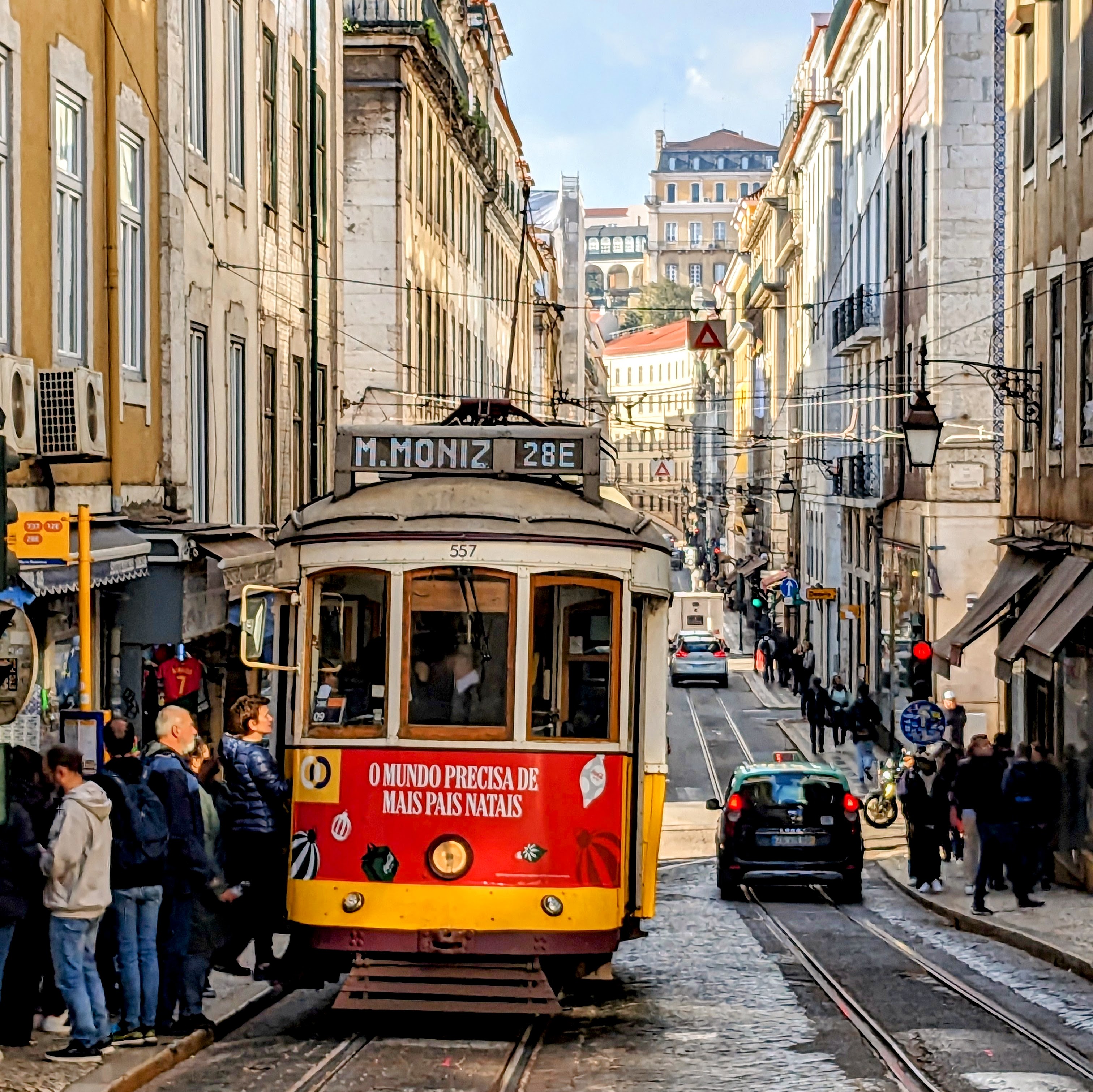
Ride historic tram 28E
- What the guides say: The 28E is a yellow tram that travels through the steep and narrow streets of the city’s historic districts. It is frequently crowded with passengers. The ride is notably bumpy and serves as a method of public transportation that also functions as a tour of the Baixa and Estrela areas.
- What they don’t tell you: Tram 28, a vehicle of such charming antiquated design that it masks its true nature as a crowded, jostling metal box that takes you on a circuitous and dizzying journey through narrow streets, entirely at the mercy of its preordained and possibly disastrous route. The cost of a single tram ticket purchased on board is €3.20; however, one may also use any number of public transit passes to pay.
- Go for: A scenic, rickety ride through the steepest and most famous streets of Lisbon.
- Cost: €3.30 (onboard) or included in the 24h transport pass (€7.25).
- Best Time: To get a seat, board at the start of the line (Martim Moniz or Campo de Ourique) very early in the morning.
- Photography: Standing at the back of the tram allows for great shots of the tracks receding into narrow streets.
- Warning: This tram is notorious for pickpockets; keep your bags in front of you.
- Verdict: It is a yellow, rattling time machine that doubles as a mobile sauna and a target for pickpockets; despite being a crowded, jostling metal box, it remains the most charming way to risk a minor collision while ascending a hill.

Ride the Elevador de Santa Justa (Santa Justa Lift)
- What the guides say: This iron elevator was designed in the Neo-Gothic style. It functions as a means of transport between the Baixa district and the Largo do Carmo. It features intricate metalwork and a platform at the top that provides a view of the city’s rooftops.
- What they don’t tell you: This is a literal elevator, constructed of a great many pieces of wrought iron. One must wait in a very long line to ride this lift, a wait so extensive it is likely to cause a person to reconsider their life choices and question the very purpose of their existence. The purpose of the lift itself is to save a person from having to walk up a hill, which, while a noble intention, is merely a short-term solution to a more permanent problem.
- Go for: A Neo-Gothic iron elevator connecting the lower streets to the Carmo Square.
- Cost: €6.20 (includes the viewing platform).
- Eiffel Tower: It was designed by a student of Gustave Eiffel (the man behind the Eiffel Tower).
- Planning Tip: The queue is often 1+ hour. To see the view for free, walk behind the Carmo Convent ruins and access the top platform via the walkway.
- Photography: Shoot the lift from the ground at night when it is beautifully illuminated.
- Verdict: You will spend an hour standing in a line just to avoid a ten-minute walk, a trade-off that makes zero sense until you reach the top and see the Baixa rooftops spread out like a geometric dream; it is the city’s most beautiful shortcut.


Take a walking tour
- What the guides say: A walking tour involves traveling on foot to hear accounts of historical events, such as the Inquisition or the revolution of 1974. Walking allows one to observe the calçada Portuguesa, which are the patterned stone pavements, and to find locations that are not accessible by larger vehicles.
- What they don’t tell you: Should a person decide to embark upon a walking tour of Lisbon, they would be well-advised to prepare not for a leisurely stroll, but for a series of bewildering and strenuous hills. A walking tour is a prolonged march led by a person of a particularly cheerful disposition. This person will then begin to recount a history so full of triumphs – of great explorers and global empires – that it sounds less like a true story and more like a cruel fairytale. Your feet, meanwhile, will be in a state of constant, miserable motion. Lisbon, as you may or may not have been told, is a city of seven hills, which means that every step you take is either an arduous climb or a precarious descent.
- Go for: Contextualizing the city’s complex history, from the Inquisition to the 1755 earthquake.
- Cost: Tips-based (Free tours) or €20 – €40 for private tours.
- Best Time: Morning, before the heat and the crowds peak.
- Planning Tip: Look for a History of the Earthquake tour specifically – it changed the city’s DNA.
- Try: Hundreds of people have expressed an enthusiasm for the following tours. You may take this information as you will.
- Verdict: A high-stamina march led by a cheerful guide who will recount tales of disasters and discoveries while your calves slowly transform into stone; it is the most informative way to realize that Lisbon is never, ever flat.
Discover the Pink Street
- What the guides say: Located in Cais do Sodré, this street was formerly known for its red-light district but is now a center for nightlife. The pavement was painted bright pink as part of a renovation project. It contains many bars and clubs that remain active until the early hours of the morning.
- What they don’t tell you: The Pink Street is a short and rather famously coloured thoroughfare in Lisbon. Its official name, for what that is worth, is Rua Nova do Carvalho, and it is located in a part of the city that was once dedicated to a great deal of what is called unsavory activities. In a peculiar attempt to make it more respectable, the city decided to paint the entire street a bright and unapologetic shade of pink. It is now a place of bustling nightlife, where people flock to drink in bars with questionable names and to stand on a pavement of such an alarming hue that it serves as a daily, and nightly, reminder that you can, in fact, put lipstick on a pig.
- Go for: The vibrant pink-painted pavement and lively nightlife/bars.
- Cost: Free to walk; drink prices vary.
- Photography: Visit at 8:00 AM if you want a clean shot of the pink street without people or trash from the night before.
- Change of Function: It used to be the city’s Red Light District for sailors.
- Planning Tip: Great for a cocktail, but it can get very rowdy after midnight.
- Verdict: A former den of iniquity that has been literalized with a coat of neon paint; it is a kitschy, colorful necessity that proves if you make a street bright enough, people will forget its unsavory past long enough to take a photo and order a cocktail.


Take a day trip to Sintra
- What the guides say: Sintra is located forty minutes away by train and is characterized by mist and several eccentric palaces. Notable sites include the Pena Palace and the Quinta da Regaleira. The landscape is mountainous and wooded, a set of facts that has historically attracted both poets and monarchs.
- What they don’t tell you: Here, castles and palaces are painted in bizarre and unnatural colours and adorned with peculiar, gothic decorations.
- Go for: Fairytale palaces, misty mountains, and the colorful Pena Palace.
- Cost: Train is ~€5 round trip; Palace entries range from €10 – €20.
- Best Time: Mid-week. Avoid weekends at all costs.
- Photography: Quinta da Regaleira has the Initiation Well – an underground spiral staircase that is a photographer’s dream.
- Planning Tip: You cannot see everything in one day. Pick two main sites (e.g., Pena Palace and Quinta da Regaleira) and stick to them.
- Verdict: A misty, mountainside fever dream where the palaces are painted like birthday cakes and the gardens are filled with occult wells; it is an exhausting, overcrowded fairytale that is entirely essential to your sanity.


This, and many other distressing things, is the nature of a place like Lisbon. It is a city of hills, which means you will be walking up and down them constantly. It is a city of delicious pastries, which means you will feel a temporary sense of pleasure that is invariably followed by the knowledge that such fleeting happiness is a mere prelude to more profound and enduring troubles. It is, in short, a place where a person might look upon a beautiful sunset from a high vantage point and be reminded that even the most glorious things must eventually come to a somber and darkening end.
Further Reading
If one is in search of a less dreadful and more pleasant perspective on Lisbon, a number of additional resources exist. These are, of course, presented with the understanding that such information is often a mere sugarcoating on a very bitter pill, and should be consumed with a healthy dose of suspicion.
- Visit Lisboa
- Visit Portugal – Lisboa Region
- “Lisbon Travel Guide” from Nomadic Matt
- “Lisbon Travel Tips: What To Know Before Traveling to Portugal” from Jetsetting Fools
- “36 Hours in Lisbon: Things to Do and See” from The New York Times (paywall)
- “Lisbon funicular crash death toll climbs to 16, including American, as disaster leaves Portugal reeling” from CBS News. My apologies. It appears that there is a limited number of rose-coloured perspectives on Lisbon.