This is not a traditional travel guide. It pairs personal observations with practical advice for travelers who would rather see Canada as it is, with rough edges, loose ends, and all. Despite the tone, this guide contains practical planning advice, safety context, and logistical realities intended to help travelers decide whether Canada is right for them.
If you are of the unfortunate mind that a travel destination should be a place of quiet, polite, and endless apologies, where the landscape is so vast that it might make a person feel very, very small, then Canada is a country that will prove to be a most predictable and dreadful success. I was born in Canada and, having spent my formative years amidst this vast, cold, and disconcertingly polite dominion, I can attest to its peculiar nature. Let me be your weary guide.
To begin, you will be met with a level of politeness that is, to be frank, deeply suspicious. The people, known as Canadians, will apologize to you for things they did not do, and for things you did yourself. If you bump into them on the street, they will say “sorry” with a sincerity that suggests they have just committed a terrible crime. This excessive civility is not merely a social custom; it is a national characteristic that seems designed to disarm and confuse a person who is accustomed to the more straightforward unpleasantness of the rest of the world.
Then there is the matter of the weather, which is, for a significant portion of the year, a most unfortunate affair. The winters are a cruel and unrelenting testament to the fact that happiness, like a good pair of waterproof boots, is a difficult thing to find. The snow arrives in a blizzard of dreary white, and the cold is of a sort that seems to whisper dreadful secrets into your bones. Of course, in the summer, the sun shines with a fierce and deceptive brilliance, but this is merely a trick to make you forget the long, cold misery that is always lurking just around the corner.
The geography of Canada is, if one is being truthful, an overabundance of nature. There are forests that stretch on for so long they might as well be a story with no end, and lakes that are so large they are, in fact, referred to as great, which is to say they are a profound and unsettling expanse of water. In the west, there are mountains that rise from the earth like a series of jagged, menacing frowns, and in the east, a great, roaring cascade of water known as Niagara Falls, which is a sight so loud and so powerful that it seems to be in a perpetual state of rage.
As for the local customs and cuisine, you will be presented with a dish of French fries, cheese curds, and a brownish substance called gravy, which is known as poutine. This is not, as you might think, a meal of joy, but a culinary disaster that has become a source of national pride, a fact that in itself is a most curious and troubling predicament. And then there is the matter of the syrup, which is a liquid derived from a tree, and which the Canadians consume in an alarming quantity. This obsession with a sweet, sticky substance is not, I assure you, a sign of contentment, but rather a peculiar and unfortunate habit.
Canada at a Glance
Best Time to Visit
June to August is the sweet spot for the classic Canadian summer. This is the only time of year you can reasonably expect the mountain lakes to be liquid rather than solid, making it prime time for canoeing, hiking, and the inevitable battle against the national bird: the mosquito.
If you enjoy the aesthetic of a frozen kingdom, January and February are stunning, provided you have a coat rated for the temperature of deep space. For the leaf-peepers, September and October offer fall colors so vibrant they look like they’ve been digitally enhanced. Just be warned: in the Rocky Mountains, winter is less a season and more a permanent resident that occasionally takes a three-month vacation in July.
Currency
The Canadian Dollar ($). Canada is almost entirely cashless; you can tap your card or phone for everything from a high-end parka to a single Timbit at a drive-thru. If you do use cash, you’ll notice the bills are colorful, plastic, and smell vaguely of maple syrup (a national legend that Canadians will neither confirm nor deny).
Note that the tipping screen is a mandatory part of the social contract here. Expect to tip 15-20% at restaurants, bars, and for hair stylists. Also, prepare for sticker shock: the price you see on the tag is never the price you pay. 5% to 15% sales tax is added at the register, a final mathematical surprise to keep your brain sharp.
Language
Canada is officially bilingual, but in reality, it’s a tale of two linguistic worlds. English is the default across most of the country, delivered with a polite rising intonation and the occasional “eh.”
However, step into Quebec, and you are in the heart of the Francophonie. While you can survive in Montreal with English, your efforts to speak French will be met with much more warmth (or at least less confusion). In New Brunswick, the only officially bilingual province, you might hear Chiac – a chaotic and wonderful blend of both languages that will leave you wondering if you’ve actually forgotten how to speak either one.
Cost Level
High. Canada is not a budget destination. Between the vast distances that require expensive domestic flights (which can cost more than flying to Europe) and the high cost of dining out, your wallet will feel the altitude.
Housing and hotels in Vancouver and Toronto are priced like luxury commodities, though you can still find value in the Atlantic provinces or the prairies. On the bright side, the tap water is world-class, and the scenery is free – though the gas required to reach said scenery will cost you a small fortune.
More Dire Travel Warnings About Canada
It is a peculiar and indeed, rather unsettling task to speak of a place where the dangers are not of the more violent and theatrical variety. The various governmental bureaus, in their dreary fashion, have issued their advisories regarding the land of Canada, and I must, with a heavy heart, convey to you a most unusual set of warnings. Unlike so many places in this miserable world, this country is not particularly prone to catastrophe, and one must instead be on the lookout for a more mundane, and therefore all the more insidious, sort of misfortune.
- Petty Crime: This is not the stuff of great schemes or grand robberies, but rather the sort of surreptitious snatching of a purse or the swift breaking of a car window. It is a reminder that even in a place that appears safe and orderly, there are always unscrupulous individuals who find some perverse pleasure in taking what does not belong to them. One is advised to guard one’s belongings with the same vigilance a person would use to guard a secret from a particularly persistent rumor.
- Unique Legal and Border Issues: The advisories speak of firearms, which are regarded in this land with a solemn and serious disapproval, and a person who unknowingly carries one could find themselves in a most dreadful predicament. Even more unnerving is the peculiar and altogether unsettling rule that strangers in uniforms may examine the secrets stored on one’s electronic devices, a violation of privacy so profound it would make even the most hardened bad guy blush.
- Natural Disasters and Weather: The advisories warn of the brutal cold of a Canadian winter, a force so harsh and unforgiving it could turn a person into a frozen popsicle, and of the distant, but nonetheless dreadful, threat of wildfires in the drier seasons. It is a reminder that even when people behave themselves, the world itself is a place of endless woe.
These are just some of the misfortunes that await you in Canada. And although current as I write this, these travel advisories are ever-shifting documents, meaning that you, as a traveler, are in a constant state of uncertainty. You must check these advisories again and again, like a lighthouse keeper scanning for ships in the fog. But even then, you will not have peace of mind, for a disaster can strike at any time, in any place, and in any form. To travel is to accept that you are living in a state of suspended dread.
Here are links to the most current travel advisories from these governments.
- U.S. Department of State Travel Advisory for Canada
- United Kingdom Foreign Travel Advice about Canada
So, as you can see, even the most sober and formal of sources agree that Canada is not a place for the faint of heart. It is a country of layered sorrows, each one more complex and bewildering than the last. Do not say you were not warned, for the warnings are, I am afraid, everywhere.
Practical Realities
Public Transport
In the corridors of Toronto or Montreal, the subways and streetcars hum with a predictable, urban grit. However, once you leave the city limits, the concept of public transport becomes purely theoretical. Canada is a country designed for wheels – specifically four of them, equipped with winter treads. The national rail service, VIA Rail, is charming and scenic, but it operates on a timeline that suggests the journey is more important than actually arriving. If you are trying to get to a small town without a car, you are either hitching a ride with a friendly stranger or waiting for a bus that may or may not exist on Tuesdays.
Rental Car Reality
Renting a car is a high-stakes survival exercise in the Great White North. In the winter, you aren’t just driving; you are piloting a steel vessel through a landscape of black ice and blinding whiteouts. You must scan the ditches like a hawk. If you see a Moose Crossing sign, it is not a suggestion; it is a warning that a 700kg beast with the height of an SUV and the spatial awareness of a boulder is currently considering standing in the middle of the highway. Hitting a moose is not an insurance claim; it’s a total reimagining of your car’s interior.
Restaurant Timing
The service is exceptionally polite, which usually means your server will ask how everything is tasting at the exact moment your mouth is full of poutine. Tipping is not a reward for excellence; it is a social contract that starts at 18% and climbs toward 25% for anyone who didn’t actively insult you. In rural areas, the local diner closes at 7:00 PM on the dot. If you arrive at 7:01 PM, the closed sign will be flipped with a Canadian “sorry,” but the kitchen remains dead to you.
Bureaucracy
Digital life is a strange cocktail of high-speed connectivity and monopolistic pricing. You can pay for a beaver tail with your watch, but your roaming data will cost more than the flight that got you here. While the government portals are sleek, the tax is a phantom that only appears at the cash register. The price you see on the tag is never the price you pay; a mysterious HST or GST will be added at the end, leaving you to do frantic mental math while the person behind you waits with polite, quiet impatience.
Pace of Life
The local motto is “Just out for a rip,” which implies a casual, unhurried approach to everything from a trip to the hardware store to a cross-country move. This philosophy manifests as an obsession with the weather – a Canadian will spend forty minutes discussing the humidity just to avoid a ten-second awkward silence. Do not mistake the polite Canadian for a pushover; they are simply masters of the aggressive apology. They will say “sorry” while you are standing on their foot, but it is actually a subtle command for you to move.
Popular Destinations (and Why They May Disappoint)
A visit to Canada might seem like a harmless, even pleasant, undertaking. It is, after all, a country renowned for its politeness and its vast, uninhabited spaces, which at a glance would seem to offer a temporary respite from the relentless misery of the world. Do not be fooled. The landscape of Canada, much like the human heart, is a cold and treacherous place, and each destination offers its own peculiar and unsettling brand of despair.
- Toronto is a city of such bewildering and relentless construction that one might suspect it is not so much a place as a permanent and ongoing state of being built. The central feature, a tower of such obscene and unnecessary height, is a monument to humanity’s need to stare down upon its own insignificance, and those who pay good money to be lifted to its summit are merely paying for the privilege of a more profound and dizzying sense of their own smallness. The city is a confusing jumble of shiny new buildings and older, more solemn structures, a combination that gives one the distinct feeling of attending a funeral that has been interrupted by an enthusiastic, yet slightly disoriented, parade.

- Calgary, a city that fancies itself as a hub of cheerful, cowboy-hatted hospitality, is a cruel and peculiar contradiction. It is a place of such profound flatness that one is perpetually reminded of the long, empty stretches of life that are yet to come. The sky here, while undeniably vast, is often occluded by a thick, oppressive blanket of smoke from faraway wildfires, a seasonal reminder that even in a place of great distance, you can never escape the consequences of the world’s slow, agonizing burn. The city’s famous Stampede, a festival of parades and rodeos, is a chaotic and noisy display of humanity’s stubborn desire to pretend it is not living in an era of relentless, oil-fueled uncertainty.
- Edmonton, a city so far north it seems to be actively trying to flee the rest of civilization, offers a brand of misery that is both extreme and relentless. The climate, for instance, is a constant and jarring reminder of the world’s indifference, swinging from one temperature so cold it could shatter a glass to a heat so oppressive it would melt a person of delicate disposition. To make matters worse, the city has attempted to distract from its own bleakness with an enormous and bewildering shopping mall, a place so vast and labyrinthine that it could easily swallow a small village and still have room for an indoor water park and a full-sized ice rink. One can only assume its purpose is to trap people inside so they will not be forced to confront the dreary landscape outside its doors.

- Vancouver, a city nestled between a great, cold ocean and a series of unforgiving mountains, is a place where nature’s beauty is so overwhelming it seems to be actively mocking the human attempt to build anything of lasting value. The famous Stanley Park is a vast and verdant wilderness, a place where one is forced to contemplate the cruel fact that even a walk in the woods requires a specific and well-marked path, lest one become irretrievably lost and devoured by a bear. The city’s famous Suspension Bridge is a structure of such terrifying height and dubious stability that to cross it is to deliberately put oneself in a position of peril for no good reason other than a photograph, which is, I believe, the very definition of a grave mistake.
- Halifax, a city perched on the edge of the vast, unforgiving Atlantic, is a place so steeped in the tragedies of the sea that it feels like a perpetual and mournful elegy. It is here that the unidentifiable victims of a famous shipwreck were brought, and it is here that a terrible explosion once tore the city asunder, a grim reminder that all human progress is fragile and can be undone in a single, fiery moment. The air, meanwhile, is perpetually thick with the smell of the sea, a scent that is undeniably beautiful but also serves as a constant, salty reminder of all the lives that have been lost and all the sorrows that have washed ashore.
- Montreal, a city of a distinctly French character, is a place so saturated with the charming but mournful sounds of the accordion and the clatter of cobblestone streets that it feels like a perpetual and profoundly romantic tragedy. The old city, with its narrow streets and ancient buildings, is a beautiful and atmospheric place, which is to say it is the sort of beauty that reminds one of a tragic story from long ago that a kind person would never mention. You will be tempted to indulge in plates of poutine, a culinary concoction of such baffling and heavy ingredients – fried potatoes, cheese curds, and a thick, brown gravy – that it serves as a powerful and immediate reminder that not all good ideas are, in fact, good.
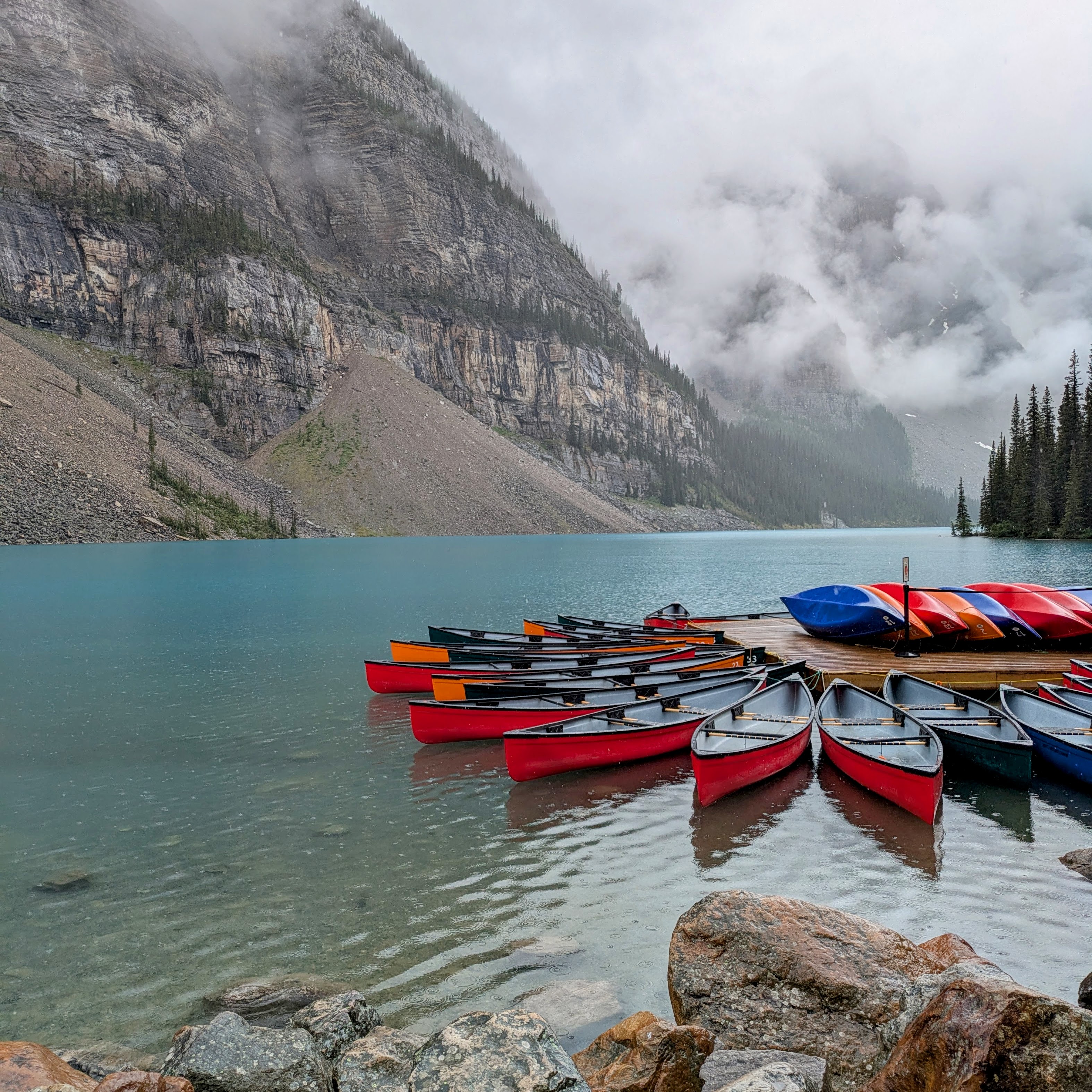
- Banff, and the Canadian Rockies in general, are a collection of mountains of such immense and overwhelming size that they serve as a constant and nagging reminder of how little control a person has over their own existence. The lakes, an improbable shade of turquoise, are quite stunning to look at, but their cold, glacial waters are a sharp and chilling metaphor for the indifference of the natural world. One may be tempted to hike a winding trail, but a person of good sense knows that a trail will only lead you further and further into a place you will almost certainly regret having entered.

- And Jasper National Park, much like its more famous counterpart, is a place of such immense, natural beauty that one cannot help but feel a profound sense of foreboding. The mountains here are so sharp and so unyielding, the forests so dark and so deep, that a person with a sensitive disposition could easily become convinced that a life spent in such a place is a life not worth living. The famous Icefields, a river of frozen, ancient water, is a chilling and stark reminder that even the most beautiful things in this world are merely a slow and inevitable march towards a profoundly cold and unforgiving end.

- Quebec City is a fortress of such stoic and unyielding grandeur that it feels less like a city and more like a permanent and unmoving rebuke to the very idea of modernity. The cobbled streets of the old city, the imposing Château Frontenac, a hotel that looks like a particularly solemn castle – all of these things are beautiful, of course, but their beauty is the kind that reminds you of a time when life was, in all likelihood, even more difficult and uncomfortable than it is today. To visit is to be a part of a vast, slow-moving procession of tourists, all shuffling dutifully from one ancient courtyard to the next, much like a line of particularly listless sheep.
- And lastly, the truly unforgivable Niagara Falls. A colossal, deafening, and relentless cascade of water that serves no purpose other than to remind a person of the terrifying power of things they cannot possibly control. To stand before it is to be a part of a large, jostling crowd of others, all of whom are straining their necks and raising their voices to be heard over the perpetual roar, much like a particularly uncoordinated and pointless choir. You will be soaked by the mist, jostled by the crowds, and question what poor choices led you here.

Who Canada Is (and Isn’t) For
✔️ Good for:
- Those who value politeness: People who enjoy a predictable environment of excessive civility and endless apologies.
- Nature lovers: Travelers seeking vast, uninhabited spaces, world-class tap water, and free scenery like forests, mountains, and great lakes.
- Summer adventurers: Those visiting between June and August for hiking and canoeing when the lakes are finally liquid.
- Winter enthusiasts: People who appreciate the aesthetic of a frozen kingdom and have gear rated for extreme cold.
- The unhurried: Travelers who align with the “Just out for a rip” philosophy and don’t mind spending 40 minutes discussing the weather.
- The tech-savvy: Visitors who prefer a cashless experience and paying for things via tap-to-pay.
❌ Not ideal for:
- Budget travelers: Those looking for a cheap destination; domestic flights, dining, and city housing are very expensive.
- Fans of straightforward unpleasantness: People who prefer conflict, passion, and a lack of dreary politeness.
- The impatient: Anyone relying on public transport outside of major cities or expecting a fast-paced social contract.
- The mathematically averse: Travelers who don’t want to deal with sticker shock from unlisted sales taxes and mandatory 15–25% tipping screens.
- Those seeking safety from nature: People intimidated by the menacing geography, cruel winters, or the constant threat of a 700kg moose standing in the road.
- Sensitive dispositions: Those who might feel very, very small or find a profound sense of foreboding in the massive, indifferent scale of the landscape.
So if you are looking for a vacation full of conflict, passion, and a general lack of dreary politeness, you would be well-advised to steer clear of Canada. For it is a place of vast, quiet spaces, of polite and unnerving people, and of a weather that will leave you with a lingering sense of cold and an unshakable feeling of what is known as “meh.”