Dear fellow traveler, if you’re looking for yet another delightful “Top 10 Things to do in Banff list,” you have opened the wrong page. For starters, you will notice – if you have any talent for counting at all – that this list does not contain ten items. A list of ten would suggest a sense of completeness and order that simply does not exist in this wretched world. These recommendations are culled from my own harrowing experiences, though I have included a few locations I have not yet visited, solely because I have heard whispers of their greatness and feel a desperate, perhaps foolish, urge to see them for myself before something goes horribly wrong.
I must caution you: while the tone of this guide is somewhat grim, the logistical information contained within is – most distressingly – entirely accurate. I have meticulously recorded prices and logistical advice with a level of accuracy that is frankly exhausting. Every detail was correct at the time this document was published, though in a world as unstable as ours, accurate is a word that should always be whispered with a note of caution. You may use this information to plan your journey with terrifying efficiency, though why you would want to arrive at your destination any sooner is a mystery that I have no desire to solve.
A great many people, when they hear the name Banff, conjure up an image of majestic mountains and sparkling lakes, as if they were a child looking at a picture book with no sense of the inevitable dangers that lie between the pages. This is, of course, a gross oversimplification. Banff is not a place for the naive or the unprepared. It is a place of great beauty, to be sure, but a place where a person’s vacation can turn from a pleasant sojourn to utter chaos with the swiftness of a falling boulder. As you read on, I will be forced to recount a list of activities that are, for reasons that escape me, considered to be the best that Banff has to offer. This list should be used with utmost caution, for it merely glosses over the peril of slippery rocks on a hiking trail, the unfortunate possibility of encountering a bear on a peaceful forest path, or the sheer misery of a sudden hailstorm on an otherwise sunny afternoon. I feel it is my duty to lay bare these truths, so that you, fellow traveler, may face the glorious, terrible wilderness of Banff not with a blissful ignorance, but with the grim fortitude of a person who is expecting a great deal of trouble.
If this is your first stop in Canada, read The Unfiltered Truth About Traveling in Canada.
Best Things to See and Do in Banff (And Why They Might Disappoint You)
In any given metropolis, there is a list of Best Things to See and Do, an optimistic and misleading phrase that suggests these activities will be entirely delightful and without peril. Such a list, however, is merely a catalog of places where one can witness something curious, or perhaps even perform a curious deed oneself. One should approach this list with caution and a healthy dose of suspicion, as no one can truly promise that what you see and do will be anything but an experience of dreadful consequence.
While I endeavor to furnish you with the costs of regular adult admission for the various locales of interest, you must understand that the proprietors of these places will almost certainly offer lesser prices for children, students, the elderly, and other groups in order to make a simple transaction more complicated. You should also be aware of the Pursuit Pass, which helps you save up to 40% on the top area attractions.
The Deception of the Picturesque
These locations offer beauty that feels manufactured, unnatural, or predatory. They are traps of aesthetic perfection that mask a deeper, more unsettling reality.
Paddle a canoe on Lake Louise
Website | Map | Parking and Transportation | Canoe Rental
- What the guides say: Gliding across the turquoise waters of Lake Louise in a red canoe is a quintessentially Canadian activity. Surrounded by the Victoria Glacier and rugged peaks, the perspective from the water is significant. The water possesses a milky blue glow, which is caused by shimmering glacial silt rather than magic or spilled paint.
- What they don’t tell you: To witness this lake is to feel that some terrible deception is at play. Its water is an impossible shade of turquoise, a colour that one finds in precious stones, not in nature. To paddle a canoe upon it is to disturb a flawless reflection, a sacrilegious act that feels strangely wrong, as if you are leaving a wake in a painting.
- Go for: The quintessential Canadian Rockies experience – gliding across turquoise, glacial-fed waters with the Victoria Glacier as your backdrop.
- Cost: Starting from approximately $110 CAD per hour (rentals from the Fairmont Boathouse). Bringing your own canoe is free, but requires a self-certification permit to prevent invasive species.
- The Color: The lake’s vivid color comes from rock flour – fine silt suspended in the water that refracts light.
- Best Time: Arrive before 8:00 AM. Not only is the water at its calmest for paddling, but the parking lot often fills up by sunrise. If you can’t get a spot, use the Parks Canada Park and Ride shuttle from the Lake Louise Summer Gondola area.
- Verdict: You will pay a princely sum to float upon a liquid sapphire that looks suspiciously like a spilled bottle of Gatorade; it is a serene, sacrilegious act of disturbing a mirror-perfect painting while pretending your arms aren’t tiring after ten minutes of quintessential labor.

Stand on the edge of Moraine Lake
Website | Map | Parking and Transportation
- What the guides say: Frequently referred to as the Jewel of the Rockies, this lake is famous for its azure color and the Ten Peaks. Standing on the Rockpile offers a view that was once featured on the Canadian twenty-dollar bill. The color is most vivid from June through September due to light refracting off rock flour, which is a term for very small bits of crushed stone.
- What they don’t tell you: This lake, found in the ominous Valley of the Ten Peaks, is another such watery deception. The view is so famously beautiful that it has been printed on banknotes, a sign that its value is both symbolic and entirely unrelated to the currency in your pocket. To stand here is to feel like you are a small and unimportant figure in a grand and uncaring landscape.
- Go for: The Twenty Dollar View from the top of the Rockpile, overlooking a valley of ten jagged peaks and impossibly blue water.
- Cost: Free to view, but you must pay for a shuttle or commercial transport (shuttles approximately $8 CAD).
- Planning Tip: Since 2023, personal vehicles have been banned on Moraine Lake Road. You must book a Parks Canada shuttle, Roam Public Transit, or a private tour in advance.
- Avalanche Risk: The lake is seasonal and usually only accessible from June to mid-October; the road closes in winter due to extreme avalanche risk.
- Verdict: A view so perfect it’s literally currency; you must brave a logistical shuttle-nightmare just to feel like a microscopic footnote in a valley of ten indifferent stone giants.


Journey to Peyto Lake
- What the guides say: This glacial-fed lake is renowned for being shaped remarkably like the head of a wolf. When viewed from Bow Summit – the highest point on the Icefields Parkway – the water appears as a solid, bright turquoise. A paved hike leads to a viewing platform, providing a vantage point that is among the most photographed in North America.
- What they don’t tell you: This lake is shaped like a wolf’s head, an unnerving detail that many people seem to overlook in their enthusiasm for its beauty. It is a reminder that even the most serene landscapes have a predatory nature, that they are not always what they seem.
- Go for: A short hike to a viewpoint that reveals a lake shaped remarkably like a wolf’s head, boasting an electric blue hue that looks photoshopped.
- Cost: Free.
- Superlative: This is the highest point on the Icefields Parkway. The viewing platform was recently renovated to accommodate more visitors.
- Other Perspective: For a quieter experience, follow the trail slightly past the main wooden platform to the upper viewpoint for a more natural, unobstructed perspective.
- Verdict: A wolf-shaped body of water with a color so aggressive it looks like a factory error; nature’s way of proving it doesn’t need a filter, even if the wolf looks a bit hungry.

Wander to Surprise Corner
- What the guides say: This viewpoint on Tunnel Mountain Road offers the surprise reveal of the Fairmont Banff Springs Hotel. From this location, the castle-like structure emerges from the evergreen forest, framed by Mount Rundle. It is the most effective spot to observe the hotel’s architectural grandeur against a backdrop of wild, unmanicured nature.
- What they don’t tell you: This viewpoint is so named because of the sudden and unexpected view it offers of a grand hotel. However, a person of foresight knows that a surprise is rarely a pleasant one. It is merely a moment where one is caught unprepared, a state that one should always endeavor to avoid.
- Go for: The postcard shot of the Fairmont Banff Springs Hotel, where the massive Castle in the Rockies emerges from the pine forest against the backdrop of Mount Rundle.
- Cost: Free.
- Photography: Located on Tunnel Mountain Road, there is a small wooden platform designed specifically for photographers.
- Best Time: This is a quick 5-10 minute stop. Visit at sunrise to see the hotel’s windows glowing against the dark mountain.
- Verdict: A scripted reveal of a hotel that looks like a castle; it is a curated moment of accidental discovery that requires zero effort and provides a view you’ve already seen on every postcard.
Find the Hoodoos
- What the guides say: These finger-like rock spires are the result of thousands of years of erosion, which is a very fancy word for the slow wearing away of things. Composed of sedimentary rock with a harder cap on top, they stand overlooking the Bow River. An interpretive trail allows visitors to view these natural sculptures and learn about the geological forces that failed to knock them down.
- What they don’t tell you: These odd, spindly rock formations seem like a geological joke. They stand on a ledge, twisted and peculiar, as if they are whispering secrets to one another. To look at them is to feel that the very ground beneath you is not to be trusted, that it is capable of forming itself into strange and unnatural shapes.
- Go for: A walk along the ridge to see surreal, finger-like sedimentary pillars created by centuries of erosion, overlooking the winding Bow River.
- Cost: Free.
- Legends: Indigenous legends tell of these Giants coming to life at night to protect the valley from intruders.
- Hike: The Hoodoos Viewpoint is accessible by car, but for the best experience, hike the 4.3km Hoodoos Trail starting from Surprise Corner; it offers constant river views (Hike Info).
- Verdict: Geological finger-puppets that have spent millennia eroding into a judgmental huddle; they are a spindly, stony reminder that the earth is constantly crumbling behind your back.
Monuments to Futility and Human Ambition
These activities highlight the absurdity of human effort, the rot beneath our progress, and the relentless, uncaring march of time.
Hike up Tunnel Mountain
- What the guides say: This is Banff’s most popular hike because it is accessible and offers a high reward. The trail consists of switchbacks – a word for a zigzagging path – offering views of the townsite and the sloping face of Mount Rundle.
- What they don’t tell you: The very name of this mountain is a lie, for there is no tunnel. One is forced to climb its slopes, an act of pointless exertion, only to be rewarded with a view of the very town one has just left. It is a perfect metaphor for the human condition: a great deal of effort for no significant change in perspective.
- Go for: The most popular bang-for-your-buck hike in Banff, offering a bird’s-eye view of the townsite, the golf course, and the massive face of Mount Rundle.
- Cost: Free.
- The Name: Ironically, there is no tunnel. In the 1880s, surveyors planned to blast a tunnel through the mountain for the Canadian Pacific Railway, but they found a flatter route instead. The name stuck.
- Hike: This is a switchback-heavy, 4.3km round-trip hike. It’s manageable for most fitness levels and is a great warm-up hike for your first day in town (Hike Info).
- Verdict: A switchback-heavy ascent up a mountain with a fake name; you will climb 2.4km just to look down at the hotel you could have walked to in five minutes.
Take a cruise on Lake Minnewanka
- What the guides say: Known as the Water of the Spirits by the Stoney Nakoda people, this is the largest lake in the park. It is used for motorboat tours, fishing, and diving. The latter activity reveals a submerged village from 1912, which is now underwater because the lake was dammed, not because the villagers were particularly bad at swimming.
- What they don’t tell you: This lake holds a submerged town beneath its waters, a watery graveyard of human ambition. A cruise on its surface is not just a tour; it is a voyage over a buried past, a place where a community was drowned in the name of progress, a grim and silent secret.
- Go for: A scenic boat cruise or a lakeside stroll on the largest lake in Banff National Park – the Water of the Spirits.
- Cost: Free to visit; Boat cruises approximately $60–$80 CAD.
- Dam: There is a literal ghost town (Minnewanka Landing) submerged beneath the lake’s surface, a result of damming in 1941. Scuba divers actually visit the underwater ruins.
- Boating: This is one of the few lakes in the park where powerboats are allowed.
- Aurora Borealis: If you’re there in winter, it’s one of the best spots near town to see the Northern Lights.
- Verdict: A boat trip over a drowned ghost town; it is a scenic, wind-swept voyage that proves humans will happily dam a valley and then pay $70 to sail over the wreckage.
Explore the Town of Banff
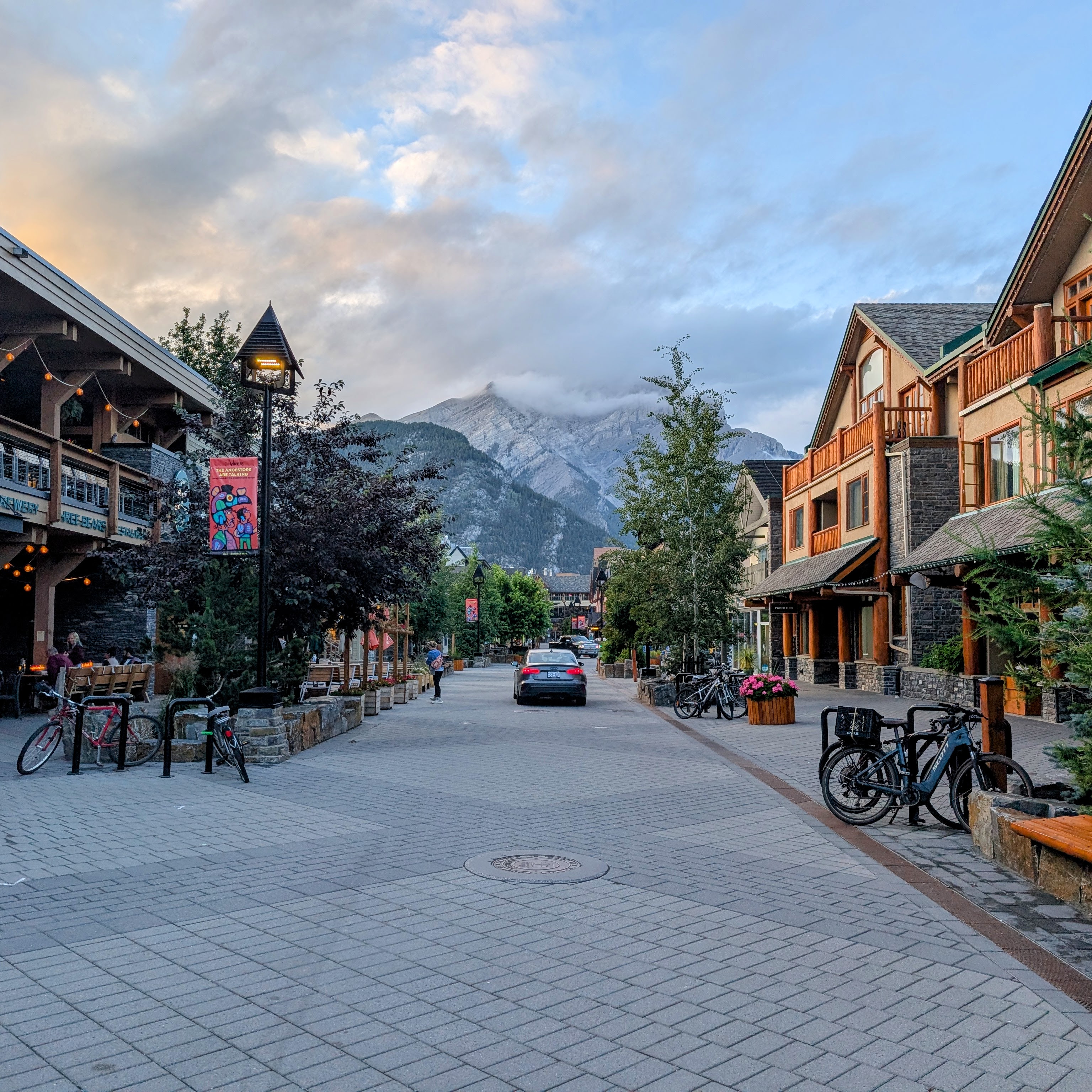
- What the guides say: Located at an elevation of 1,383 meters, this resort town is the heart of the park. Its main street, Banff Avenue, is aligned with Cascade Mountain, providing a dramatic view for anyone walking to buy a postcard. Filled with boutiques and galleries, it serves as a basecamp for mountain adventures and relaxation after a day of being cold.
- What they don’t tell you: The streets are crowded with an unnerving number of people who all appear to be having a good time, a spectacle that is both bewildering and deeply suspect. Every shop sells souvenirs, each a plastic bauble meant to help one remember a moment that, in truth, they will soon forget.
- Go for: High-end shopping, world-class dining, and the feeling of being in a Swiss-inspired alpine village surrounded by 360 degrees of peaks.
- Cost: Free to explore (aside from parking fees).
- Superlative: Banff was the first municipality to be incorporated within a Canadian national park.
- Parking: Banff Avenue is often pedestrian-only during the summer months. Park your car at the free Train Station parking lot (Map) and walk into the core to avoid the traffic gridlock.
- Verdict: A high-altitude shopping mall where the views are grand and the crowds are grander; it is the most beautiful place in the world to get stuck in a pedestrian traffic jam.

Visit the Cave and Basin National Historic Site
- What the guides say: This is the birthplace of Canada’s National Parks. The site features a thermal spring inside a cavern found by railway workers in 1883. Visitors can explore the steaming cave and learn about the rare Banff Springs Snail, a creature that lives in sulfur vents and does not care about human history at all.
- What they don’t tell you: This is the very place where the national park system was born, a fact that would suggest a certain historical gravitas. Instead, you will find bubbling, sulfurous waters in a dimly lit cave, a place that smells faintly of rot and decay, a grim reminder that all great things begin in the primordial muck.
- Go for: Exploring the birthplace of Canada’s National Park system and seeing the rare Banff Springs Snail in natural thermal springs.
- Cost: Approximately $10 CAD; Free during special Parks Canada promotions.
- History: It was discovered by railway workers in 1883, leading to the creation of the protected park. You can walk through a tunnel into a cavern filled with the smell of sulfur and sparkling blue water.
- Swimming: You cannot soak here anymore (to protect the snails), but if you want to swim, head to the Banff Upper Hot Springs nearby (Map).
- Verdict: A damp, sulfurous hole in the ground where Canada’s park system was born; go for the history, stay for the smell of primordial rot and tiny, unimpressed snails.
Consider the Bow Falls
- What the guides say: Located below the Fairmont Banff Springs Hotel, these falls are easily reached from the town center. The turquoise water of the Bow River drops over a rock ledge, creating mist and foam. Film historians may recognize it as a location for the movie River of No Return, starring Marilyn Monroe, though she is no longer there.
- What they don’t tell you: The water here cascades over a series of rocks, a perpetual motion that serves as a ceaseless reminder of the river’s relentless, unceasing flow toward a destination it does not seem to care about. It is a place to contemplate the relentless forward march of time, a most depressing exercise.
- Go for: A powerful, wide waterfall located just a short walk from the town center, famously featured in Marilyn Monroe’s 1953 film River of No Return.
- Cost: Free.
- Accoustics: The falls aren’t famous for their height, but for their thundering volume and accessibility.
- Hike: Walk the Bow River Trail from the town bridge to the falls (about 1.5km); it’s a flat, scenic forest walk that beats trying to find a parking spot at the falls themselves (Hike Info).
- Verdict: A thundering, wide-format waterfall that lacks height but thrives on drama; it is a short walk from town to watch water commit to its downward trajectory with reckless abandon.

The Illusion of Control and Safety
These experiences force one into unnatural structures or confront them with the chilling indifference of the wild.
Ascend Sulphur Mountain via the Banff Gondola
- What the guides say: An eight-minute ride transports you to the summit of Sulphur Mountain. A boardwalk leads to Sanson’s Peak, offering a 360-degree view of six mountain ranges. The summit features an interactive center and dining, making it the most efficient way to stand on top of a mountain without the inconvenience of climbing it.
- What they don’t tell you: A person of caution knows that anything that promises a ride to the top is likely to be followed by an equally precipitous descent. This mechanical contraption will lift you into the sky, offering a view of a town so perfect it must be a miniature model, a dollhouse of human endeavor against an uncaring, stony backdrop.
- Go for: A stunning 8-minute ride up Sulphur Mountain to a boardwalk with sweeping views of six different mountain ranges.
- Cost: Approximately $60–$75 CAD (Prices fluctuate based on demand; booking in advance is cheaper).
- At the Top: At the top, there is a multi-level discovery center, a world-class restaurant (Sky Bistro), and a 1km boardwalk to Sanson’s Peak.
- Hike: If you are physically fit, you can hike up the 5.5km switchback trail for free and pay half price for a one-way download on the gondola.
- Verdict: A $70 shortcut to a boardwalk; it offers a 360-degree perspective for those who find climbing to be an unnecessary obstacle to a good photo.
Walk the trail to Johnston Canyon
- What the guides say: This canyon was carved into limestone by rushing water over thousands of years. Steel catwalks built into the walls allow you to walk deep into the gorge to see the Lower and Upper Falls. In winter, the falls freeze into blue ice pillars, which are often used by ice climbers who enjoy hanging from frozen water.
- What they don’t tell you: The name canyon itself suggests a place of separation and isolation. The path is a series of suspended catwalks, a most unnatural way to experience the world. You are forced to follow a pre-determined route, clinging to a metal rail while a river roars below, a perfect metaphor for a life where one is trapped on a set path with danger just beneath their feet.
- Go for: Walking on cantilevered catwalks built directly into the limestone canyon walls, leading to the dramatic Lower and Upper Falls.
- Cost: Free.
- Hike: This is one of the most popular attractions in the park (Hike Info).
- Ink Pots: Beyond the Upper Falls lie the Ink Pots – seven cold mineral springs that bubble to the surface.
- Ice Walking: In winter, this is a top spot for ice walking (crampons/ice cleats are mandatory), as the waterfalls freeze into giant blue pillars of ice.
- Verdict: A crowded metal catwalk bolted to a gorge; you are trapped on a steel path with hundreds of strangers, all staring at a river that would very much like to wash you away.

Dine at the Fairmont Banff Springs Hotel
Website | Map | Rundel Bar | Afternoon Tea
- What the guides say: Often called the Castle in the Rockies, this National Historic Site opened in 1888. Built in the Scottish Baronial style, it features grand halls and spiral staircases. Even if you are not a guest, you may visit the public spaces for high tea, a meal consisting of small sandwiches and a great deal of etiquette.
- What they don’t tell you: This hotel, often referred to as a castle, is a sprawling, gothic structure that looms over the town. It has more than its share of unsettling rumors and corridors that seem to lead nowhere. A meal here is not just an indulgence; it is an act of entering a grand and peculiar labyrinth from which you may never truly escape.
- Go for: A walk through the Castle in the Rockies, featuring grand ballrooms, medieval-style hallways, and the stunning Rundle Bar.
- Cost: Free to enter the public areas/lobbies.
- Ghosts: Opened in 1888, the hotel is rumored to be haunted by a Ghost Bride and a helpful bellman named Sam Macauley.
- Tea: You don’t have to be a guest to enjoy the property. Book an afternoon tea or a drink at the Rundle Bar terrace for one of the best views in the Bow Valley.
- Verdict: A meal inside a Gothic labyrinth where you are more likely to encounter a ghost than a cheap appetizer; it is the most elegant way to feel like an uninvited guest in a stone castle.
Find a big horn sheep
- What the guides say: These animals are known for the large, curved horns found on the rams. While they appear calm, they are wild animals; it is best to maintain a safe distance and keep your camera ready for their displays of agility on the rocks.
- What they don’t tell you: These animals, with their immense and curving horns, have an unsettling way of staring at you from the side of the road with a look of profound indifference. They seem to know instinctively that all paid employments absorb and degrade the mind, and they watch with pity as you spend your hard-earned wages to stand in the dirt and look at them.
- Go for: Spotting Alberta’s provincial mammal – massive, curved-horn sheep that frequent the rocky slopes.
- Cost: Free.
- Where to Look: You are most likely to spot them along Lake Minnewanka Road (Map) or the Mount Norquay lookout (Map).
- Safety: Always stay at least 30 meters (3 bus lengths) away. They may look docile, but they are wild animals and can be aggressive, especially during the fall rut season. Never feed them; it’s illegal and carries heavy fines.
- Verdict: An encounter with a wild animal that treats your $50,000 SUV with the same indifference it treats a rock; it is a humbling lesson in who actually owns the mountain.

And so, we come to the end of this unfortunate catalog of activities in Banff. You have now been warned, in no uncertain terms, that the best things to do in this national park are simply the most popular ways to find yourself in a state of mild peril. A sensible person, having absorbed this information, would likely decide to stay home, perhaps to read a book in a comfortable chair by a fire, far from the unpredictable whims of nature. But if you are not a sensible person – and the very fact that you are considering a trip to Banff suggests you may not be – then I can only offer this final piece of advice: pack for every possible misfortune. When you return, you will have a story to tell, not of a perfect holiday, but of close calls and minor calamities – a tale far more truthful than the postcards and brochures would ever lead you to believe.
Further Reading
If one is in search of a less dreadful and more pleasant perspective on Banff, a number of additional resources exist. These are, of course, presented with the understanding that such information is often a mere sugarcoating on a very bitter pill, and should be consumed with a healthy dose of suspicion.
- Banff & Lake Louise Tourism
- Parks Canada – Banff National Park
- The Banff Blog
- “36 Hours in Banff: Things to Do and See” from the New York Times (paywall)