This is not a traditional travel guide. It pairs personal observations with practical advice for travelers who would rather see Luxembourg as it is, with rough edges, loose ends, and all. Despite the tone, this guide contains practical planning advice, safety context, and logistical realities intended to help travelers decide whether Luxembourg is right for them.
Luxembourg.
A name that, when uttered, tends to produce a silence as vast and empty as a disused opera house on a Tuesday afternoon. One might imagine, as is the tendency of those who have been insufficiently miserable, that this small patch of European geography – an entity known as the Grand Duchy (a title so unnecessarily grand it almost certainly conceals something wretched) – is a charming, albeit tiny, jewel box of a country.
I am here, as ever, to disabuse you of any such cheerful notions.
Luxembourg is, to be perfectly blunt, a place where the scenery is almost suspiciously pleasant. Imagine, if you will, being shown a collection of perfectly maintained, historical sites – castles, scattered across the forested hills of the Ardennes, like so many misplaced gargoyles. These are places where one might expect a wicked step-mother, a nefarious taxi-driver, or perhaps a secret giggle of mediocre clowns to be plotting their next scheme. Yet, they merely stand, looking picturesque, a constant, nagging reminder that history is often less dramatic than one would hope.
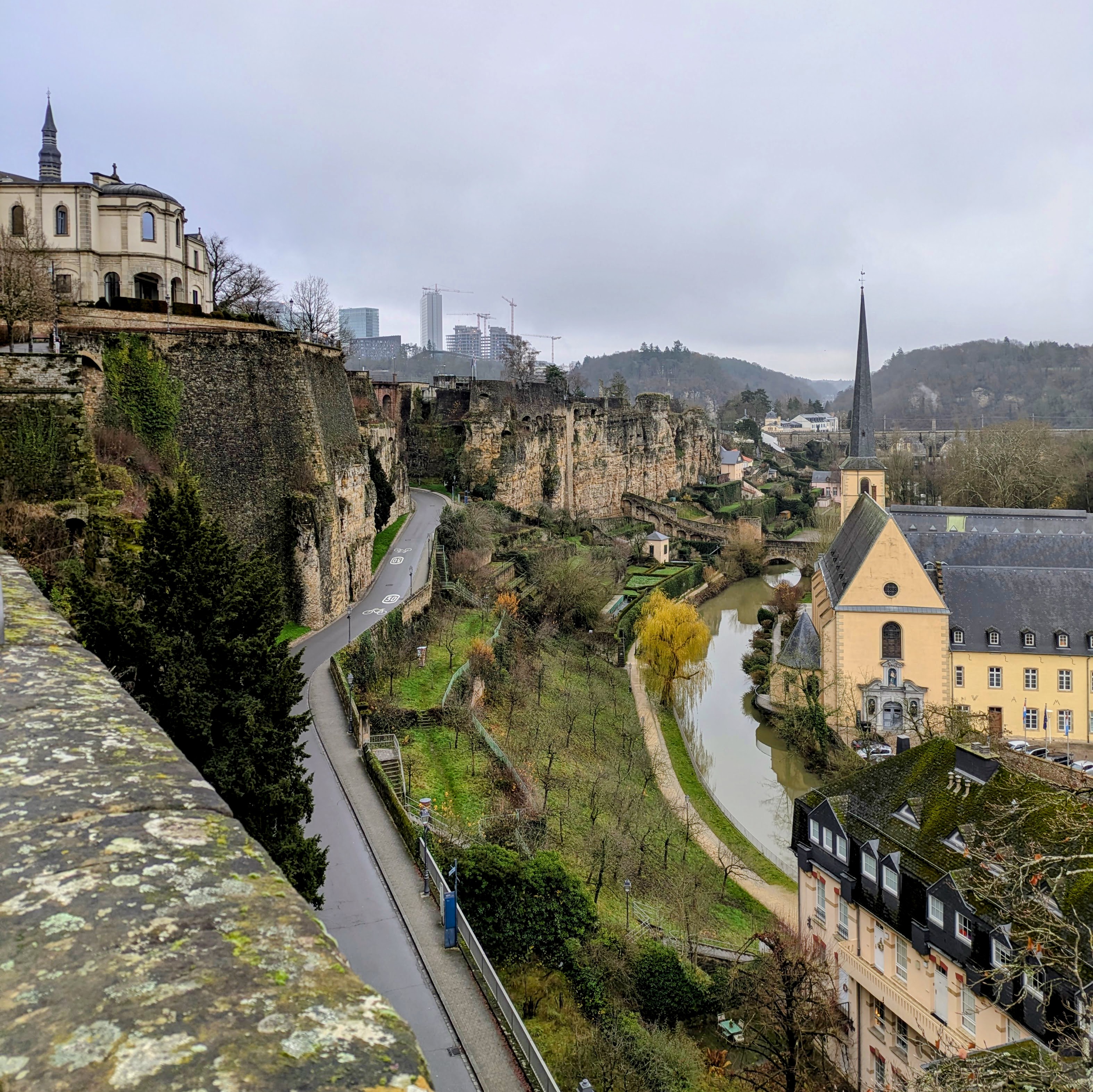
The capital, Luxembourg City, is itself a masterclass in concealed peril. It is a city of two distinct levels, cleaved by a yawning ravine and crossed by dizzying viaducts and bridges. The upper town sits high, brimming with banks and European institutions – which is to say, vast, imposing buildings filled with paperwork, legal jargon, and the sort of financial figures that might make a nervous liberal faint dead away. Down below, in the Grund district, you find a quaint, canal-side area. Do not let the charming stone houses and peaceful river views fool you; being nestled at the bottom of a precipice merely means one is perfectly positioned to be trapped should the upper part decide to collapse, or should a sinister individual decide to lower a particularly heavy cage.
And the fortifications! Known, with a certain pomp one associates with people who have too much time on their hands, as the Gibraltar of the North. A vast network of subterranean tunnels, the Casemates, are carved into the rock. These dark, damp passageways were once shelters, but now serve as a chilling testament to the fact that, throughout its long history, Luxembourg has always anticipated something terrible being just around the corner. A truly sensible person would take this as an omen and immediately turn back.
Furthermore, it is a multilingual nightmare. They speak Luxembourgish, French, and German, and often English besides. This means that any unfortunate visitor can be misunderstood in at least four different languages, which is four more opportunities for a crucial misunderstanding to lead to a truly dreadful outcome.
My own foray into this deceptive landscape occurred last December, dragging my mother and youngest brother along for a festive descent into the abyss. We found ourselves in Luxembourg City’s Christmas markets, which are essentially traps set with glowing lights and the scent of Gromperekichelcher – fried potato cakes designed to lull you into a state of greasy complacency.
While my brother marveled at the Ferris wheel, I looked up at the frosted spires and realized the true horror: even in the biting chill, the city remained unflinchingly orderly. We glided across Luxembourg City on a high-speed tram – free of charge, naturally – clutching our scarves as if they could protect us from the sheer competence of the national infrastructure. My mother remarked on how lovely the Adolphe Bridge would look under a dusting of snow; I, however, could only think of the terrifying drop beneath us. It was a holiday of chillingly smooth logistics, leaving us far too much time to contemplate the eerie silence of a perfectly functioning society.
And so, the final, and perhaps most distressing, element is the complete and utter efficiency. The public transportation, for instance, is free for the entire country. Imagine! No fumbling for coins, no frustrating ticket machines – just a seamless, uninterrupted journey that allows you to arrive at your next dismal destination with unnerving speed. It is utterly devoid of the minor, necessary frustrations that allow one to prepare for the larger, more crushing misfortunes of life.
Luxembourg at a Glance
Best Time to Visit
May to September is when the Grand Duchy truly shines. The weather is mild enough to explore the fairytale valleys and castle ruins without needing a heavy coat. June 23rd is the National Day, featuring fireworks and a street party in the capital that manages to be both upscale and chaotic.
If you enjoy a moody, cinematic vibe, December is lovely for the Christmas markets in Luxembourg City’s Place d’Armes.
January to March is the quiet season – it’s damp, grey, and cold, but it’s also the only time you’ll have the Vianden Castle almost entirely to yourself.
Currency
The Euro (€). As a global financial hub, Luxembourg is extremely card-friendly. You can tap-and-go for your Michelin-starred dinner or your magnets at the souvenir shop.
Cash is rarely required in the city, but it’s handy to have a few Euros if you’re heading into the Mullerthal region (Little Switzerland) for a hike and want to stop at a small village bakery.
Tipping is low-stress; service is included in the price, so rounding up a couple of euros is the standard way to show you enjoyed the service. In a country with one of the highest GDPs in the world, the staff is well-compensated, so they won’t chase you down for a percentage.
Language
Luxembourg is a linguistic marvel (and a bit of a headache). It has three official languages: Luxembourgish, French, and German.
- French is the primary language for shops, restaurants, and hotels.
- German is heavily used in the media and the police force.
- Luxembourgish is the language of the heart, spoken at home and among friends.
Fortunately, English is spoken by almost everyone in the capital, which is home to expats from all over the world. You can start a sentence in French, pivot to German, and finish in English, and the local waiter will likely keep up without blinking. A simple “Moien“ (Hello in Luxembourgish) is the secret handshake that will instantly endear you to the locals.
Cost Level
High. There’s no sugarcoating it: Luxembourg is expensive. Hotels, cocktails, and dining out will take a significant bite out of your budget, often rivaling prices in Zurich or London.
However, Luxembourg has a cheat code for travelers: All public transport (trains, trams, and buses) is 100% free. You can hop on a train in the capital and head to a castle in the north without spending a single cent. This makes it one of the few places where your transit budget is exactly zero, allowing you to reallocate those funds to an extra glass of local Moselle sparkling wine (Crémant).
More Dire Travel Warnings About Luxembourg
If my descriptions were not enough to dissuade you, a series of solemn warnings issued by the governments of the United States, the United Kingdom, and Canada describe countless hidden dangers one should consider. These agencies, with their penchant for understatement, categorize the country under “Normal Precautions.”
- World War II Unexploded Ordnance: Perhaps the most unsettling truth is that the very ground beneath your feet may harbor a lethal secret. The U.S. and Canadian governments warn that the rural landscape, particularly where the Battle of the Bulge once raged, remains a graveyard of unexploded bombs and shells. To stray from a marked trail is to invite a sudden and explosive end, a grim reminder that the violence of the past is never truly buried, merely waiting for an unwary step to bring it back to life.
- Petty Crime and Organized Scams: All three advisories speak of the crimes of opportunity that plague the unsuspecting traveler. Your belongings, you see, are merely temporary guests in your pockets. Pickpockets haunt the Luxembourg City Railway Station and the Place d’Armes with a sinister efficiency, while smash-and-grab thieves turn your locked vehicle into a glass-strewn disappointment. Even the simple act of withdrawing cash is fraught with peril, as skimming devices and distraction artists wait to ensure your funds vanish into the digital ether.
- Public Transport and Traffic Perils: While Luxembourg offers the free use of its trains and buses, this is a bureaucratic trap for the unobservant. Should you cross a border without a ticket for the foreign portion of your journey, or fail to produce identification upon request, you will face the cold reality of an on-the-spot fine. Furthermore, the winter months bring a mandate for specific tires; to find yourself on a slushy road without the proper rubber is to invite the immediate impounding of your vehicle – a most unfortunate halt to any journey.
- Civil Unrest and Heightened Awareness: Even in this supposed bastion of stability, large groups of people can become a source of profound unrest. The U.S. Embassy warns of demonstrations that may erupt near government buildings, turning a pleasant walk into a labyrinth of traffic disruptions and shouting crowds. In the wake of recent regional tensions, travelers are urged to maintain a heightened situational awareness, a polite way of saying that one must look over one’s shoulder even in the most crowded of plazas.
- The Cruelty of Biometric Borders: The UK and Canadian governments highlight the April 2026 implementation of the Entry/Exit System, a new technological sorrow for the weary traveler. You must now surrender your fingerprints and facial images to a digital web of surveillance before being allowed entry. It is a slow and tedious process, a hidden delay designed to trap the traveler in a web of bureaucracy and long lines, ensuring your arrival is marked by frustration rather than joy.
These are just some of the misfortunes that await you in Luxembourg. And although current as I write this, these travel advisories are ever-shifting documents, meaning that you, as a traveler, are in a constant state of uncertainty. You must check these advisories again and again, like a man trying to count the grains of sand in an hourglass before they all slip through his fingers. But even then, you will not have peace of mind, for a disaster can strike at any time, in any place, and in any form. To travel is to accept that you are living in a state of suspended dread.
Here are links to the most current travel advisories from these governments.
- Government of Canada Travel Advice and Advisories for Luxembourg
- U.S. Department of State Travel Advisory for Luxembourg
- United Kingdom Foreign Travel Advice about Luxembourg
So, as you can see, even the most sober and formal of sources agree that Luxembourg is not a place for the faint of heart. It is a country of layered sorrows, each one more complex and bewildering than the last. Do not say you were not warned, for the warnings are, I am afraid, everywhere.
Practical Realities
Public Transport
Luxembourg is the first country in the world to make all public transport completely free. You can hop on a tram, a bus, or a train without ever reaching for your wallet – a feat of national wealth that feels like living in a utopian simulation. The tram in Luxembourg City is a silent, glass-walled miracle of modern engineering. However, because it costs nothing, the schedule is treated by locals as a suggestion rather than a law. During rush hour, the nation’s roads become a giant, motionless parking lot for the 200,000 frontaliers (cross-border workers) who commute from France, Belgium, and Germany every single day.
Rental Car Reality
Renting a car is unnecessary for the city, but vital if you want to explore the craggy castles of the Ardennes. The roads are impeccably paved – as if they are scrubbed with toothbrushes nightly.
I feel it is my solemn duty to make you aware of the fuel tourism chaos. Because taxes are lower, gas stations near the borders are chaotic hubs where thousands of Europeans flock to save a few cents. If you find yourself in a queue behind thirty cars with French plates, you aren’t in a traffic jam; you’re just witnessing the regional economy in action.
Also, beware of the country lane blindness – the hills are steep, and the local drivers know every curve of the vineyard roads far better than you do.
Restaurant Timing
The service is multilingual and formal. Your waiter will likely speak four languages fluently but will address you with a reserved, old-world professionalism. Dining in Luxembourg is a serious affair; the country has one of the highest densities of Michelin stars per capita.
Lunch is a strictly guarded 12:00 PM to 2:00 PM ritual. If you try to find a hot meal at 3:00 PM, you will be met with a polite but firm “non” from a kitchen that has already been scrubbed to a mirror shine.
Bureaucracy
Digital life is exceptionally high-tech, yet deeply rooted in traditional banking culture. This is a land of private wealth, so while you can pay for a croissant with your phone, the underlying systems are built on layers of security and discretion.
And despite the country’s small size, the bureaucracy moves with the deliberate pace of a well-aged wine. Everything closes early on Saturdays and remains tightly shut on Sundays. If you lose your passport on a Sunday, the entire machinery of the state is effectively out to lunch until Monday morning.
Pace of Life
The local philosophy is “Mir wëlle bleiwe wat mir sinn” – “we want to remain what we are”. It is a motto of quiet, prosperous stability. This is not a country of frantic energy or loud self-promotion; it is a place of understated luxury and hidden wealth. Do not mistake the quiet streets of the capital for boredom; life happens behind the thick stone walls of the villas and in the lush, green valleys. Life is measured in “Crémant” (local sparkling wine) and the belief that being small is no obstacle to being significant.
Popular Destinations (and Why They May Disappoint)
Luxembourg is a small country – so small, in fact, that if you blink while driving through it, you may find yourself in Belgium, which is a different kind of misfortune altogether. It is a place of high finance, low valleys, and a history so dense it could be used as a doorstop.
Should you insist on witnessing these sites for yourself, here is a list of locations where you might find both crowds and a lingering sense of dread:
Luxembourg City & Surroundings (Fortifications, Modernity, Culture)
- Luxembourg City, the capital, is a bewildering labyrinth of high walls and low valleys. You may find yourself strolling along the Corniche, a promenade falsely advertised as beautiful, only to realize you are terribly high up and prone to vertigo. Below, in the Grund, the ancient stones stand as a testament to the fact that misery has existed in many centuries, not just your own. Do not try to count the underground Casemates; the endless tunnels will only remind you of your own inescapable fate.

The Ardennes & The North (Highlands, Castles, Forests)
- Vianden is dominated by a grotesque, magnificent fortress that looms above the town. The sight of Vianden Castle may momentarily distract you from your troubles, which is unfortunate, as one should never forget one’s troubles. You may ascend to the parapet via a chairlift, an ill-conceived device guaranteed to rattle your nerves and leave you suspended over a terrifying drop, much like the plot twist in a truly depressing novel.
Mullerthal & Little Switzerland (Rock Formations, Hiking, Nature)
- Müllerthal (Little Switzerland) is a deceptively named region, for nothing about deep gorges, treacherous, narrow caves, and dark, dripping forests suggests Swiss cheerfulness. The Schiessentümpel waterfall may look picturesque in photographs, but up close, it is merely cold, wet, and utterly indifferent to your suffering. If you choose to walk the Müllerthal Trail, bring sturdy boots and a very short will to live, as you will need both.
The Moselle Valley (Vineyards, Riverscapes, Wine)
- In the Moselle Valley, the land is cruelly fertile, producing wines that promise momentary pleasure followed by inevitable regret. The villages, like Schengen, are famous for agreements that remove borders, which is unfortunate, as one often needs borders to keep unpleasant people out. You will be tempted to enjoy the scenery; resist. The gentle river flows slowly, a constant, silent reminder that time marches toward an unpleasant conclusion.
Who Luxembourg Is (and Isn’t) For
✔️ Good for:
- The Logistically Minded: Travelers who appreciate complete and utter efficiency and a utopian public transport system that is 100% free.
- Lovers of Understated Luxury: Those who prefer quiet, prosperous stability over frantic energy or loud self-promotion.
- Linguistic Adventurers: People who enjoy a linguistic marvel where you can start a sentence in French and finish it in English.
- Fairytale Enthusiasts: Travelers seeking suspiciously pleasant scenery, including Ardennes forests and clifftop castles.
- The Food-Disciplined: Those who enjoy high-end, Michelin-starred dining and can adhere to strict 12:00 PM – 2:00 PM lunch rituals.
❌ Not ideal for:
- Budget Travelers: Those on a tight leash, as the country is expensive and rivals the price points of Zurich or London.
- The Vertigo-Prone: Anyone uncomfortable with yawning ravines, dizzying viaducts, or chairlifts suspended over terrifying drops.
- Improvisational Diners: People who expect to find a hot meal at 3:00 PM or shop on a Sunday when the state is effectively out to lunch.
- Careless Hikers: Individuals who might stray from marked trails in the Ardennes, where unexploded bombs and shells from WWII still linger.
- Anxious Commuters: Drivers who cannot handle fuel tourism chaos at the borders or the motionless parking lot of 200,000 daily cross-border workers.
In summary, Luxembourg is a small, quiet, exceedingly wealthy, and dangerously efficient Grand Duchy, filled with charming landscapes and foreboding historical architecture. It is the sort of place that lulls one into a false sense of security before revealing its utterly unsettling lack of visible calamity. Despite my warnings, I suspect you will go anyway. A person of good sense would be better served to rearrange the furniture in your mind and leave everything else untouched.
Here’s more dismal content you might enjoy:


Something went wrong. Please refresh the page and/or try again.