Dear fellow traveler, if you’re looking for yet another delightful “Top 10 Things to do in Reykjavik list,” you have opened the wrong page. For starters, you will notice – if you have any talent for counting at all – that this list does not contain ten items. A list of ten would suggest a sense of completeness and order that simply does not exist in this wretched world. These recommendations are culled from my own harrowing experiences, though I have included a few locations I have not yet visited, solely because I have heard whispers of their greatness and feel a desperate, perhaps foolish, urge to see them for myself before something goes horribly wrong.
I must caution you: while the tone of this guide is somewhat grim, the logistical information contained within is – most distressingly – entirely accurate. I have meticulously recorded prices and logistical advice with a level of accuracy that is frankly exhausting. Every detail was correct at the time this document was published, though in a world as unstable as ours, accurate is a word that should always be whispered with a note of caution. You may use this information to plan your journey with terrifying efficiency, though why you would want to arrive at your destination any sooner is a mystery that I have no desire to solve.
Reykjavik is a city perpetually cloaked in a chilling mist. I can attest that the prospect of a visit to this place is a dreadful one indeed. For what is Reykjavik but a small collection of colourful houses perched on the edge of a great, unforgiving land? It is a city that offers opportunities for wonder and being forced to confront the terrible and indifferent might of nature. You might find yourself gazing at the Northern Lights, or perhaps you will be foolish enough to bathe in a geothermal pool. If you, like so many others, find such prospects oddly compelling, then this article will serve as a miserable guide to the places you must see.
If this is your first stop in Iceland, read Why You Should Skip Iceland for Your Next Vacation.
Best Things to See and Do in Reykjavik (And Why They Might Disappoint You)
In any given metropolis, there is a list of Best Things to See and Do, an optimistic and misleading phrase that suggests these activities will be entirely delightful and without peril. Such a list, however, is merely a catalog of places where one can witness something curious, or perhaps even perform a curious deed oneself. One should approach this list with caution and a healthy dose of suspicion, as no one can truly promise that what you see and do will be anything but an experience of dreadful consequence.
While I endeavor to furnish you with the costs of regular adult admission for the various locales of interest, you must understand that the proprietors of these places will almost certainly offer lesser prices for children, students, the elderly, and other groups in order to make a simple transaction more complicated. You should also be aware of the Reykjavík City Card, which permits free access to an alarming number of sights and the local public transportation, alongside discounts for yet more sights.
The Fickle Cruelty of the Natural World and Expensive Imitations
These are the activities that force you to confront the immense, indifferent power of Iceland’s desolate landscape, either by subjecting yourself to its severe elements or by paying an exorbitant sum for a mere, technologically-enhanced imitation of its grandeur. In both cases, the experience is a profound disappointment.
Hunt the elusive and often disappointing Northern Lights
- What the guides say: A natural light display caused by solar particles colliding with the Earth’s atmosphere, a process which sounds violent but simply results in swirling ribbons of color. They are best viewed between September and April, provided the sky is not obscured by clouds, which it frequently is. Many people depart the city for aurora hunts – driving a bus into a dark field and waiting in the cold for the sky to do something interesting.
- What they don’t tell you: The Northern Lights, or what scientists call the aurora borealis, are not, as some might wish, a magical display put on by sprites or benevolent ghosts. Instead, they are a cruel and unusual phenomenon that occurs in the night sky, a visual representation of a celestial disaster. When a stream of charged particles, released from the sun’s upper atmosphere, collides with the gases in our planet’s atmosphere, the result is a light show that is not so much beautiful as it is unsettling, with shades of green, purple, and red dancing across the sky in a way that suggests a great deal of trouble is afoot. In Reykjavík, a city that is often shrouded in a kind of perpetual gloom, people wait for this spectacle in the cold and dark, with a kind of desperate hope that is often unrewarded, as the lights are as fickle and unreliable as a promise made by a fairy.
- Go for: The ethereal, dancing curtains of green, pink, and violet light in the night sky. Since the sun is at its solar maximum in 2026, the activity is currently at a decade-high peak.
- Cost: Free (DIY) | ISK 10,000 – ISK 15,000 (Bus tour) | ISK 25,000+ (Super Jeep)
- Tours to try: These ones come particularly highly rated:
- Cloud Factor: A high Kp-index (geomagnetic activity) is great, but clear skies are more important. Use the Vedur.is cloud cover forecast.
- Free Re-run: Most tour companies offer a free do-over if the lights don’t show up on your first night. Book this for your first night in Iceland to maximize your chances.
- Photography: Use a tripod and a slow shutter speed (8 – 15 seconds). Your smartphone might have a night mode that works, but a steady hand is key!
- Verdict: It is a cruel, high-stakes game of hide-and-seek with a solar storm; you will pay a great deal to stand in a dark field, but if the sky finally decides to dance, the refund is a memory that defies description.
Submerge oneself in a geothermal lagoon
Blue Lagoon: Website | Map | Tickets – Sky Lagoon: Website | Map | Tickets
- What the guides say: Iceland is known for its bathing culture, which is a polite way of saying that people enjoy sitting in very hot, mineral-rich water while their faces are exposed to freezing air temperatures. The Blue Lagoon is the most famous of these, but the Sky Lagoon offers an infinity edge overlooking the North Atlantic, allowing you to look at a very cold ocean while staying quite warm yourself.
- What they don’t tell you: These large steaming expanses of water heated by the Earth’s own inner turmoil are common and peculiar features of the landscape around Iceland. These lagoons contain water that is filled with various minerals, like silica and algae, which are said to be good for your skin. For this reason, these lagoons are considered spas, a place for relaxation and, for some, a cure for unfortunate skin conditions. They are a place where people, in their strange and predictable way, pay a great deal of money to enter, where they may be seen slathering white mud on their faces and ordering overpriced drinks from an in-water bar.
- Go for: Soaking in mineral-rich, naturally heated waters while surrounded by lava fields or ocean views.
- Cost: Blue Lagoon: Approximately ISK 11,990+ | Sky Lagoon: Approximately ISK 13,990+ (depending on the day and options you choose).
- Blue Lagoon vs. Sky Lagoon: The Blue Lagoon is iconic for its milky-blue water and silica mud (near the airport). The Sky Lagoon is closer to downtown Reykjavík and features an infinity edge overlooking the Atlantic.
- Reservations: These sell out weeks in advance. Do not show up without a pre-booked time slot.
- Verdict: Whether you choose the iconic Blue or the infinite Sky, it is a quintessential Icelandic indulgence that proves there is no better feeling than being boiling hot in a freezing world.
Journey out of the city and into the Golden Circle
- What the guides say: A 300-kilometer loop of road that connects three specific landmarks. It includes Þingvellir National Park, where the Earth’s tectonic plates are slowly moving apart; the Geysir Geothermal Area, where the ground periodically spits water into the air; and Gullfoss, a waterfall that is very loud and very wet. It is a popular route for people who wish to see the most famous parts of the island in a single day.
- What they don’t tell you: This popular tourist route from Reykjavik consists of three main stops. It is a grueling, over-scheduled day, completely ignoring the wise counsel that one should never put off till tomorrow what may be done day after tomorrow just as well. First, you will find yourself in Þingvellir National Park, a desolate place where two continents are slowly moving away from each other. Next is the Geysir Geothermal Area, where the ground itself is in a state of constant, boiling distress. Finally, you will reach Gullfoss, a magnificent and noisy waterfall with a rainbow, but with no pot of gold to be found.
- Go for: Iceland’s greatest hits in one day: Þingvellir National Park (where tectonic plates meet), Geysir (exploding hot springs), and Gullfoss (the Golden Waterfall).
- Cost: Free (DIY with rental car, minus parking) | ISK 10,000 – ISK 18,000 (Guided Bus Tour)
- Highly Rated Tours: The general consensus is that these are good tours:
- Strokkur: While the famous Great Geysir is mostly dormant, its neighbor Strokkur erupts reliably every 6 – 10 minutes. Keep your camera ready!
- The Hidden Stop: Add a stop at Kerið (Map | Website), a volcanic crater lake with neon-blue water and red earth walls.
- Lunch Tip: Stop at Friðheimar Tomato Farm (Map | Website | Reservations) to eat tomato soup inside a greenhouse heated by geothermal energy.
- Verdict: The ultimate geological power-trip; it is a dense, awe-inspiring day of greatest hits that serves as the perfect introduction to a planet that is still very much under construction.

Experience FlyOver Iceland
- What the guides say: An immersive flight simulation located in the Grandi Harbor District. It involves sitting in a chair with your feet dangling in front of a spherical screen while machines spray you with mist and scents. This allows you to experience the sensation of visiting glaciers and volcanoes without the inconvenience of actually traveling to them or risking a volcanic eruption.
- What they don’t tell you: This is a tourist attraction where you pretend to fly over Iceland. It is not an authentic experience but rather a convincing and unsettling imitation. It is a peculiar sort of amusement where a great deal of money is paid to be strapped into a chair. The experience is a kind of technologically advanced theater. You are seated in a contraption that lifts you into the air in front of a giant spherical screen. The film, which has been shot from helicopters, gives the disconcerting illusion of soaring over Iceland’s many desolate and beautiful landscapes. You will be jostled and swayed, and subjected to various effects, such as mist, wind, and scents, each meant to add to the illusion that one is not merely sitting in a very expensive movie theater. It is a sad truth that a person can pay a great deal of money to pretend to fly over a country that is right outside, a peculiar kind of laziness that is all too common in the world.
- Go for: A high-tech, 4D flight simulation that uses a massive wraparound screen, motion seating, and scent/mist effects to make you feel like you are soaring over Iceland’s most inaccessible glaciers and fjords.
- Cost: ISK 5,690 (Online) | ISK 5,950 (Onsite).
- The Scent of Iceland: You will actually smell the lupine flowers and the damp moss as you fly over the landscape.
- Perfect Rainy Day Activity: Located in the Grandi Harbour District, it takes about 35 minutes total and is the best way to see the whole country if you don’t have time to drive the Ring Road.
- Verdict: A brilliant, sensory-rich shortcut that provides the best views in the country without the vertical hike; it’s the only way to smell a glacier while staying perfectly dry.
Gaze upon the Imagine Peace Tower
Website | Map | Ferry and Tour Tickets
- What the guides say: An outdoor art installation on Viðey Island created by Yoko Ono. It consists of a beam of light that reaches heights of up to 4,000m, which is a very long way for light to travel just to make a point. It is powered by geothermal energy and is lit during the autumn and early winter months. The base features the words “Imagine Peace” in twenty-four languages, ensuring that almost anyone who can get close enough to read it will understand the request.
- What they don’t tell you: The Imagine Peace Tower is located on a small, windswept island in a bay off Reykjavík. It was conceived by Yoko Ono, a person whose life has been full of strange occurrences, in memory of her late husband, the musician John Lennon. The tower is not a tower at all, but rather a great beam of light projected into the sky from a stone wishing well. The well is inscribed with the words “Imagine Peace” in a great many languages. The light, which is powered by geothermal energy, is only lit during certain times of the year, a frustrating and unhelpful schedule that serves as a reminder that even the grandest gestures of peace are only temporary.
- Go for: A colossal tower of light designed by Yoko Ono as a tribute to John Lennon.
- Cost: Free (to view from the city) | ISK 17,650 for ferry to Viðey Island with walking tour.
- Best Time: The tower is not lit year-round. It shines from October 9th (John’s birthday) to December 8th (the day he passed), plus a few other dates like New Year’s and the Spring Equinox.
- The Island Experience: To see it up close, take the ferry to Viðey Island. During the lighting period, evening tours include the ferry and a guide who explains the history and the wishes buried beneath the tower.
- Earth Powered: The light is entirely powered by Iceland’s geothermal energy, making it a sustainable beacon of hope.
- Verdict: A hauntingly beautiful beacon of light that turns the Icelandic night into a monumental tribute; it is a rare, quiet moment of global hope that is worth the ferry ride to witness up close.
Monuments to Misfortune and Cataloged Chaos
This collection consists of the city’s architectural behemoths and its various museums, all of which are, at their core, quiet, static attempts to categorize and present history, chaos, or rebellion in a way that is utterly lacking in the original, messy life of the thing itself.
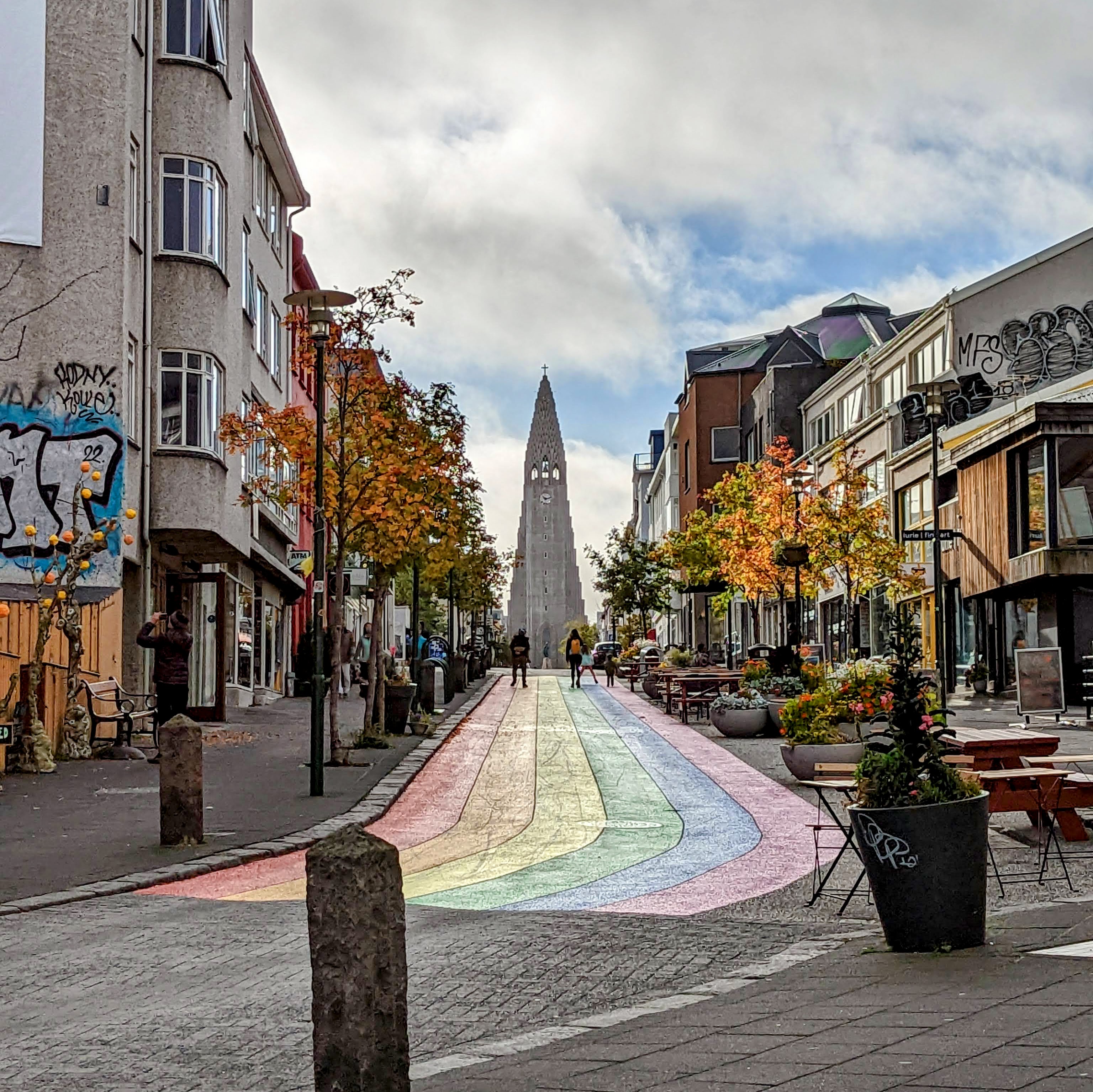
Ascend the towering, peculiar, and basalt-inspired Hallgrímskirkja (Church of Hallgrímur):
- What the guides say: A Lutheran church that is the tallest building in the city. Its exterior is designed to resemble basalt lava columns, which are hexagonal rock formations found in nature that look suspiciously like they were carved by a giant with a ruler. There is an observation deck at the top, which is a useful place to go if you wish to see the city’s colorful roofs without having to climb onto them yourself.
- What they don’t tell you: This peculiar and colossal monument stands on a hill in Reykjavík. Its construction was a long and dreary affair, lasting from 1945 until 1986, a period of time during which many people passed away, including the very man who designed it. It is a Lutheran church, though the interior is as unadorned and bleak as a well-guarded secret. It is the tallest building in the city, its bell tower providing a panoramic view that can only be described as a spectacle of urban sprawl and distant, ominous mountains. In the courtyard, a statue of Norse explorer Leif Erikson stands, a gift from the United States that arrived long before the church itself was finished, a sign that Americans, like so many people, have a habit of showing up too early.
- Go for: The most iconic landmark in the city. Its stepped concrete facade was inspired by the basalt lava columns found in Icelandic nature.
- Cost: Church entry is Free | Tower Lift is approximately ISK 1,400.
- The View: The tower offers the absolute best 360-degree view of Reykjavík’s colorful rooftops. It’s an elevator ride up, followed by a short flight of stairs.
- The Organ: Inside, look for the massive pipe organ – it has over 5,000 pipes and stands 15 meters tall. If you hear someone practicing, it’s worth sitting down for a few minutes.
- Best Time: The tower usually closes to visitors on Sunday mornings (around 10:30 AM – 12:15 PM) for church services.
- Verdict: It is a towering, concrete tribute to the geology of the island; pay for the lift to see the colorful roofs, but stay for the 5,000-pipe organ that makes the building hum with life.

Contemplate the stark, geometric beauty of the Harpa Concert Hall
- What the guides say: A building on the harbor featuring a glass facade that looks like a honeycomb. The glass is designed to reflect the Icelandic light, which means the building changes color whenever the weather changes – which, in Reykjavik, happens quite frequently. It serves as a home for the orchestra and a symbol of creativity.
- What they don’t tell you: The Harpa Concert Hall is a large and glassy building on the Reykjavík waterfront. Its construction began in 2007, but like so many plans of mice and men, it was promptly brought to a halt by the 2008 Icelandic financial crisis. For a time, it was a half-built monument to the country’s economic misfortune. However, in a turn of events that would have surprised no one, the government decided to finish it, making it one of the few things being built in the entire country at the time. The building’s exterior, a honeycomb of coloured glass, is meant to look like the basalt columns found across the island. This clever design allows the building to change colour with the light of the day, a small and temporary victory over the perpetual gloom that often hangs over the city.
- Go for: Stunning contemporary architecture. The glass facade consists of 714 irregularly shaped panels that change color depending on the light and weather, creating a kaleidoscope effect.
- Cost: Walking around the lobby is free. Prices vary for concerts, guided tours, and the Volcano Express – check the current offerings and prices.
- Night Glow: At night, the glass panels are illuminated with moving LED lights, sometimes mimicking the Northern Lights.
- Photography: The interior geometry provides incredible shadows and reflections. Head to the top floors for great harbor views without needing a tour ticket.
- Verdict: A shimmering, glass-clad victory over financial ruin; whether you’re there for a symphony or just the shadows, it is the best place in the city to watch the Icelandic light perform for free.
Discover the skeletal, steel sculpture of the Sun Voyager
- What the guides say: A stainless-steel sculpture that resembles a ship. While many people believe it is a Viking vessel, it is actually a dreamboat meant to represent progress and the sun. It is located on the waterfront, providing a convenient place for people to stand and look at Mount Esja, a mountain that stays very still while the sky turns different colors behind it.
- What they don’t tell you: This stainless steel sculpture stands on the waterfront of Reykjavík, where it reflects the ever-changing and often dreary light of the northern sky. Although it resembles a Viking ship, the artist himself insisted it was a dreamboat, a tribute to the sun and a symbol of hope, progress, and freedom. The sculpture’s tragic irony, of course, is that its creator died of leukemia a year before its completion, a tragic reminder that even the most hopeful journeys often have an unhappy ending.
- Go for: A striking stainless-steel sculpture on the waterfront.
- Cost: Free.
- Photography: This is the most photographed spot in the city. For the best shot, visit at sunrise or sunset when the steel reflects the pink and orange sky.
- Verdict: A stainless-steel promise of undiscovered territory that perfectly frames the mountains; it is the most poetic spot in the city to stand still and let the dreamboat reflect the sunset.
Explore the solemn and surprisingly interactive Saga Museum
- What the guides say: A museum that uses lifelike wax figures to recreate the history of early settlers. It covers topics such as blood feuds and the world’s first parliament, which are two very different ways of settling an argument. Visitors are permitted to wear Viking chainmail and fur capes, which is a way of experiencing the weight of history without having to actually live through a tenth-century winter.
- What they don’t tell you: The Saga Museum is not a place of great and powerful heroes, but rather a place of small figures made of wax. The museum’s purpose is to recount the Icelandic Sagas, which are a collection of ancient stories that detail the long and dreary lives of the country’s early settlers. Visitors are guided through dioramas that depict various unhappy historical moments, such as battles, the Black Death, and the beheadings of important men, all presented with an audio guide.
- Go for: A gritty, realistic walk through Iceland’s history. Life-sized wax figures and an audio guide bring the violent and heroic tales of the Icelandic Sagas to life.
- Cost: Approximately ISK 4,000.
- Photography: At the end of the tour, there is a dress-up station where you can put on authentic-style chainmail, tunics, and helmets for a photo op – included in your ticket price.
- Location: It’s located in the Grandi Harbour district, right next to the Aurora Reykjavík museum and FlyOver Iceland, making it easy to group these together.
- Intense Realism: The wax figures are remarkably lifelike (created using molds of real Icelanders). Some scenes are a bit bloody, so keep that in mind if traveling with someone with a sensitive disposition.
- Verdict: A gritty, lifelike dive into the blood feuds of the past that is worth every krona – if only for the chance to wear chainmail and realize that Viking history was far more visceral than the movies suggest.
Visit the National Museum of Iceland
- What the guides say: This institution provides a chronological journey from the arrival of Viking settlers to the present day. Its primary exhibition, titled “The Making of a Nation,” consists of a collection of 2,000 objects that survived the passage of time. Notable among these is a thirteenth-century carved door, which is a very old piece of wood that has been remarkably successful at not rotting.
- What they don’t tell you: This museum chronicles the country’s entire and often dreary history. Inside, one will find a great many artifacts, each one evidence of the fact that the lives of the early Icelanders were both difficult and short. There are swords and axes that were used for violent and regrettable purposes, and ancient clothing that was worn by people who were, by all accounts, perpetually cold. The exhibits are arranged in a timeline that begins with the settlement of the island and proceeds, with a kind of grim inevitability, to the present day.
- Go for: The “Making of a Nation” permanent exhibition. It’s a beautifully curated walk through time, from Viking settlement artifacts to modern-day independence.
- Cost: Approximately ISK 3,300.
- The Valthjófsstadur Door: Look for the famous 13th-century carved wooden door – it’s the museum’s most prized possession, depicting a knight and a loyal lion.
- Free Audio Guides: They offer excellent smartphone-based audio guides in several languages. Please don’t forget your headphones because no one else wants to listen in your language!
- Location: Situated right next to the University of Iceland, it’s a peaceful 15-minute walk from the city center.
- Verdict: A beautifully curated journey from Viking swords to modern independence; it’s the essential starting point for anyone who wants to understand how 2,000 artifacts built a nation.
Visit the Icelandic Punk Museum
- What the guides say: A museum dedicated to rebellious music, located in a former underground public toilet. The exhibits are placed inside the old bathroom stalls, which is a very efficient use of a space that people used to visit for entirely different reasons. It features instruments and photographs from the 1980s, allowing visitors to wear leather jackets and pretend they are much noisier than they actually are.
- What they don’t tell you: The Icelandic Punk Museum is a small, peculiar place, tucked away in an underground space that was once a public toilet. Inside, one will find a chaotic and cramped collection of artifacts, photographs, and clippings, all chronicling the history of a musical genre that was, by its very nature, a series of protests against the establishment. The tiled walls are covered with rebellious slogans and images of musicians with peculiar hairstyles. The museum is a reminder that even the most loud and angry of noises can be cleaned up, cataloged, and placed in a slightly damp and cramped museum.
- Go for: A raw, loud, and incredibly cool look at Iceland’s punk history, housed in a converted underground public toilet.
- Cost: Approximately ISK 2,000.
- Interactive Exhibits: You can pick up the guitars and play or put on headphones to listen to the bands that shaped the scene (like the early Sugarcubes, Björk’s first band).
- Safety First: The museum is small and the ceilings are low. If you’re tall, watch your head.
- Toilet Vibe: The museum keeps much of the original tiling and layout of the old restrooms, which perfectly captures the DIY punk aesthetic.
- Verdict: The most authentic, DIY experience in the city; it’s loud, cramped, and housed in a former toilet, which is exactly where the best punk music belongs.
Encounters with the Utterly Peculiar and Transactional
These attractions involve strange customs, questionable educational endeavors, or simply the procurement of food, all of which are rendered peculiar or unsatisfying by some underlying strangeness, inconvenience, or lack of proper condiment.
Examine the peculiar and sometimes unnerving exhibits at the Icelandic Phallological Museum
- What the guides say: A scientific collection of over 300 specimens from various mammals. These range from a 170cm portion of a blue whale to the microscopic parts of a hamster. It is an institution dedicated to academic curiosity – looking at things that might otherwise make a person blush, but doing so for the sake of science.
- What they don’t tell you: Inside this establishment, one will find a great many things preserved in glass jars and mounted on walls, each one a different specimen from the animal kingdom. There are specimens from whales, which are large and cumbersome, and specimens from hamsters, which are small to the point of being nearly invisible. There are also works of art and various items related to the subject, because even in a place this peculiar, the curator has a strange desire to fill every available space. The museum is not a place of smut or salaciousness, but rather a place of scientific inquiry and, for some, mild discomfort.
- Go for: The world’s only museum dedicated to the study of phallology. It houses over 200 specimens from nearly all the land and sea mammals found in Iceland.
- Cost: Approximately ISK 3,500.
- Size Matters: Specimens range from a massive 1.7-meter whale specimen to the tiny, almost microscopic tip of a hamster’s.
- The Bar: The museum now features The Phallic Cafe & Bistro, where you can grab a beer or a penis waffle after your tour (website).
- Human Section: Yes, there is a section for humans, featuring legal donation letters from various volunteers.
- Verdict: It is a singular, world-class achievement in biological curiosity; whether you’re there for the 1.7-meter whale specimen or a pint at the Phallic Bistro, it is an essential, surprisingly tasteful lesson in the diversity of nature.
Consume a hot dog from a small, unassuming stand
- What the guides say: A small red stand that has been selling hot dogs since 1937. The local custom is to order “eina með öllu,” which translates to “one with everything,” including two types of onions and a variety of sauces. It is a very popular place to stand in line to eat a blend of lamb, pork, and beef while the wind blows your napkins away.
- What they don’t tell you: A hot dog in Reykjavík is a matter of great importance and an unfortunate lack of proper condiments. It is made from a combination of lamb, pork, and beef, and is served in a bun with crispy fried onions, raw white onions, and a trio of sauces: ketchup, sweet mustard, and remoulade. The most famous of these is found at a small stand called Bæjarins Beztu Pylsur, where one must endure the cold and a long queue of tourists and locals, all waiting for a turn to partake in this peculiar ritual.
- Go for: The best hot fogs in town. This small stand has been serving Iceland’s unofficial national dish since 1937.
- Cost: Approximately ISK 690 per hot dog.
- How to Order: Ask for “ein með öllu” (one with everything). This includes raw onions, crispy fried onions, ketchup, sweet mustard (pylsusinnep), and remoulade.
- The Meat: Icelandic hot dogs are unique because they are made with a blend of Icelandic lamb, pork, and beef.
- Famous Fans: Everyone from Bill Clinton to Anthony Bourdain has stood in line here.
- Verdict: The ultimate Icelandic rite of passage; join the queue and discover why a humble blend of lamb and crispy onions is the most satisfying meal in the North Atlantic.

Delve into the peculiar world of Icelandic street art
- What the guides say: Large murals and graffiti that decorate the city’s walls. Many of these were created for a project called “Wall Poetry,” where artists painted their interpretations of songs. These paintings ensure that even the most boring side alley has something to say, even if it is saying it in a very haunting or geometric manner.
- What they don’t tell you: Icelandic street art is an intentional and often peculiar attempt to bring colour to a city that can be terribly gray. Much of this art is a result of a project called “Wall Poetry,” a collaboration that brought together musicians and artists to create murals inspired by songs. This has resulted in a collection of visuals that are as strange and varied as the island itself, from depictions of mythical creatures and folkloric figures to photorealistic portraits of fishermen and scenes of everyday gloom. The works are scattered throughout the city’s main streets.
- Try one of these tours:
- Go for: A self-guided walking tour of the vibrant murals that turn Reykjavík’s downtown walls into an open-air gallery.
- Cost: Free
- Where to find it: Focus on Laugavegur (Map), Grettisgata (Map), and Skólavörðustígur (Map). The murals change often, but the area around the Old Harbour also has large-scale monochrome portraits.
- Brauð & Co: Even if you aren’t hungry, go to the bakery on Frakkastígur to see one of the most brightly painted buildings in the city (Map).
- Verdict: An inspiring, open-air gallery that turns the city’s concrete into a vibrant storyboard; it is the perfect reason to wander the backstreets of Reykjavik and find a new favorite mural at every turn.
Attend Elfschool
- What the guides say: An establishment where one can learn about the Hidden People, or Huldufólk. The headmaster teaches students about thirteen different types of elves while serving tea and pancakes. It explains why some roads in Iceland are built with unnecessary curves, as it is considered rude to drive a bulldozer through someone’s invisible living room.
- What they don’t tell you: This school offers classes on elves and hidden people. The school’s headmaster, a man who has devoted his life to the subject, has never seen an elf himself, so his knowledge comes from collecting stories from people who claim to have had an encounter, which he presents with a kind of grim and factual certainty. The class, which runs for several hours, is a combination of a lecture, a discussion, and an ill-timed meal. After being repeatedly sworn to secrecy, students are given a study guide, a cup of coffee, and pancakes with whipped cream and jam, a strange combination of things to eat while listening to stories of invisible beings. The school promises that the experience is one that students will never forget, a statement that is unfortunately true.
- Go for: A fascinating, humorous, and deeply cultural lecture about the Huldufólk (Hidden People) that many Icelanders still believe in (or at least respect).
- Cost: Approximately €64 or $79 per student with a 10% discount for cash payments.
- The Diploma: You get a certificate upon completion and a 70-page textbook on elves and trolls.
- Pancake Break: The sessions (usually held on Fridays) include coffee and the best pancakes in Iceland with jam and cream.
- Magnus the Headmaster: The school is run by Magnus Skarphedinsson, a legendary storyteller who has interviewed hundreds of people claiming to have seen elves. Do not be surprised if he offers you a ride back to your accommodations after school.
- Verdict: A delightful, deep-dive into the soul of Icelandic folklore; you’ll leave with a diploma, a belly full of excellent pancakes, and a newfound respect for the invisible neighbors living in the rocks.
And so, you have been warned. Reykjavik, with its biting wind and its long, dark winters, is a city that will offer you a great many opportunities for joy. If you are one of those peculiar individuals who find such things appealing, then I am afraid that Reykjavik is the perfect destination for you. As for me, I prefer to be in a place with a distinct lack of volcanic activity, geothermal pools, and the sort of blinding, unremitting light that is said to cause awe.
Further Reading
If one is in search of a less dreadful and more pleasant perspective on Reykjavik, a number of additional resources exist. These are, of course, presented with the understanding that such information is often a mere sugarcoating on a very bitter pill, and should be consumed with a healthy dose of suspicion.
- Visit Reykjavík
- “36 Hours in Reykjavik: Things to Do and See” from The New York Times (paywall)